Our new research into connected devices in commercial real estate focuses on the installed base of IoT devices. It provides a completely fresh assessment of the industry based on the latest information.
Memoori estimates that the number of IoT connected devices installed in commercial smart buildings reached over 1.5 billion in 2022. This represents around 11.8% of the total installed base of connected devices worldwide. We forecast that the number used in commercial smart buildings will grow at a 13.7% CAGR between 2023 and 2028, reaching an estimated 3.25 billion devices by 2028.
Growth in the total installed base is driven by several factors. A greater proportion of companies are now moving beyond the conceptualization and planning phases into the adoption phase for their IoT deployments. In addition, surveys indicate a notable recent rise in the average number of IoT devices being deployed per project, with many device rollouts now including thousands or even tens of thousands of devices.
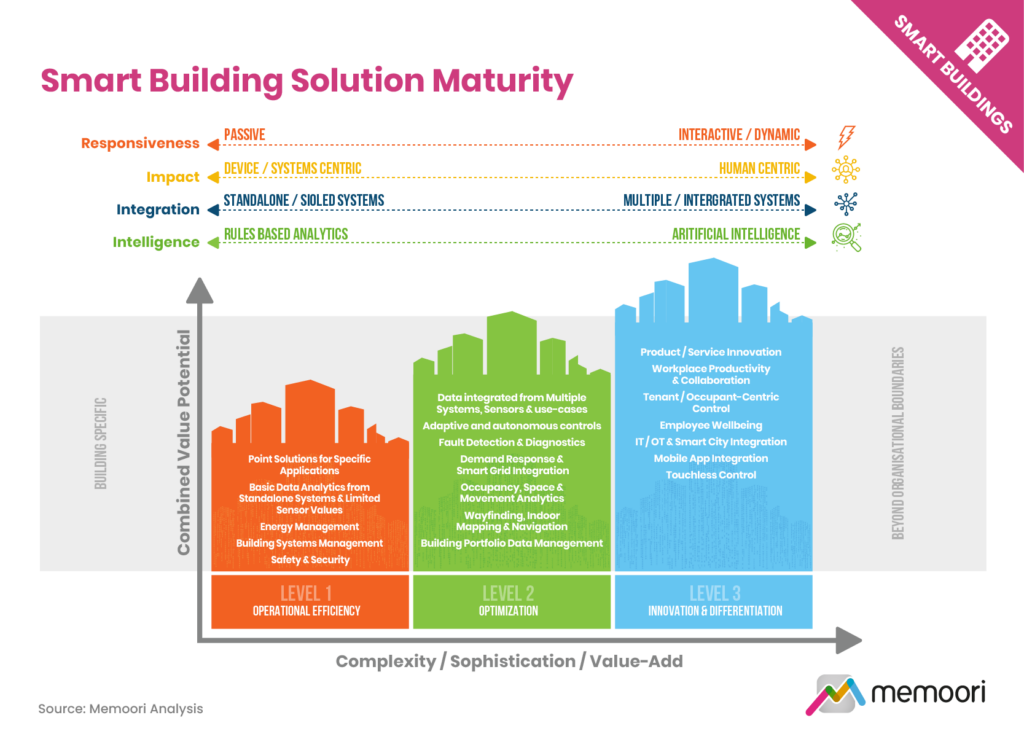
As of 2021, 33% of commercial real estate assets were still managed manually. The transition to higher levels of BIoT maturity (Levels 2 & 3 in the diagram below) is slowed by challenges such as legacy systems, cost, technical expertise, data privacy and security, interoperability, vendor lock-in, regulatory compliance, change management, and scalability. To facilitate this transition, organizations should adopt a gradual and phased approach to smart building development, prioritizing a roadmap that delivers tangible benefits to stakeholders.
The commercial real estate sector faces numerous challenges and uncertainties as it contends with the long-term shift towards remote and hybrid working practices and macro factors such as inflationary pressures on energy, labor, and materials.
The slow and uneven recovery in global office markets is creating a divide between prime and secondary office buildings. Landlords that invest in sustainability credentials, amenities, and digital connectivity will gain a competitive advantage and improve future returns, while outdated buildings risk becoming obsolete.
The report is available now and includes a spreadsheet containing the data from the report and high-resolution presentation charts showing the key findings. It is the first instalment of a two-part series, with the second report (published later in Q2) covering market sizing data and the competitive landscape. These reports are included in our 2023 Premium Subscription Service.
Connected Devices in Security & Access
By smart building application, connected devices related to Security & Access Control (including video surveillance) already make up the largest portion of connected devices, and will continue to grow at a steady 11.9% CAGR rising to 646 million devices installed by 2028.
However, our analysis suggests that sensors and devices used to monitor various forms of occupancy and space utilization will experience the highest rates of growth for any application in the coming years.
Artificial Intelligence
In the context of smart building systems, Artificial Intelligence (AI) and Machine Learning (ML) technologies are increasingly serving as innovative tools empowering building operators to collect, process, and utilize data within the building. Generative AI models, like GPT-4, offer potential benefits for BIoT systems in terms of natural language processing (NLP) and improved human-AI interactions. Integrating NLP with BIoT systems and data can provide simplified user interfaces, increased adoption, enhanced data analysis, and improved scalability.
The research provides a comprehensive analysis of how a variety of “meta-trends” and technology innovations are influencing the dynamics of the BIoT market and overall market prospects. Including analysis of the key trends influencing real estate, supply chains, ESG adoption and skills.
For only USD $2,000 (Enterprise Wide License) the report provides valuable information to companies so they can improve their strategic planning exercises and look at the potential for developing their business. For more details, visit the report page – https://memoori.com/portfolio/iot-devices-smart-commercial-buildings-2023/ or download the brochure.