The most underappreciated barrier to adopting artificial intelligence in commercial buildings is the cost and complexity of integrating it with the existing building stock.
Up to 75% of engineering effort and budget goes to making existing systems legible to the analytics layer, not to the analytics itself. The technology is not the bottleneck. The building stock is.
Our new research report is an evidence-based resource for understanding where artificial intelligence is genuinely transforming commercial building operations, and where it is not.
69 Use Cases. One Framework. A Clear Deployment Path.
Our report assesses 69 distinct artificial intelligence use cases across 12 application domains, from energy management and HVAC controls to occupancy analytics, access control, and predictive maintenance, scored across eight dimensions, including market maturity, data readiness, and business case strength.
Energy management is the only domain currently in the top deployment tier. But even within that leading category, the performance hierarchy is stark. Passive dashboards deliver around 2–3% energy savings; fault detection and diagnostics around 9%; and autonomous supervisory optimization achieves verified electric savings of approximately 12–13% in independently evaluated programs.
The difference between alerting a facilities manager to a fault and autonomously correcting it is not marginal. It is order-of-magnitude.
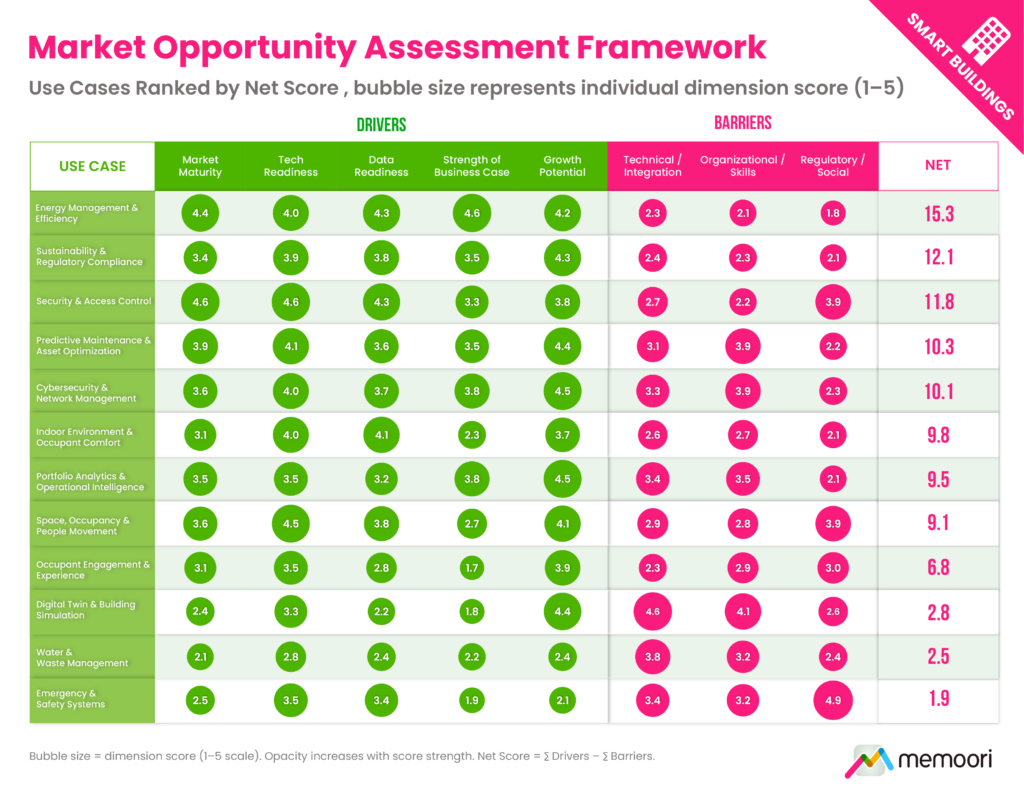
One counterintuitive finding worth noting: smaller commercial buildings consistently outperform larger ones under rigorous evaluation. The light commercial segment, historically underserved by sophisticated vendors, may represent a disproportionate near-term opportunity.
The Gap Between Pitch and Performance
Vendor-reported energy savings from AI deployments commonly cite figures of 20–50%. Independent, portfolio-scale evaluations tell a different story: verified savings consistently fall between 3–15%.
The most authoritative benchmark comes from NYSERDA’s Real-Time Energy Management program, the largest independent evaluation of building AI performance to date, covering 654 sites. Vendor-reported savings were roughly double what independent evaluation confirmed, with a realization rate of just 48% for electric savings. Our report grades every performance claim accordingly.
Artificial Intelligence: Three Phases to 2031
Our report maps a clear deployment outlook:
- Now – 12 months: Copilot tools and analytics in well-instrumented buildings. Competitive advantage comes from workflow integration depth, not the underlying model.
- 12–36 months: Portfolio-scale supervisory optimization, driven by semantic interoperability standards and building performance regulations.
- 36–60 months: Bounded autonomous control in central plant and mechanical systems where instrumentation is robust, and savings are directly measurable.
The barrier to reaching that third phase is not algorithmic. It is data infrastructure, delivery model innovation, and the industry’s willingness to meet the rigorous evaluation standards buyers are now demanding.
The Insurance Risk Nobody Is Talking About
From January 2026, standardized ISO insurance endorsements introduce absolute artificial intelligence exclusions covering bodily injury, property damage, and personal injury arising from machine learning systems.
The more autonomous control a building operator grants to artificial intelligence, the wider their potential coverage gap becomes. This risk is not on the horizon, it is already here.
Who Needs this Research?
Building owners, investors, facilities managers, system integrators, and technology vendors who want to navigate the pilot-to-scale gap with rigorous, independent evidence. Our report, AI in Smart Commercial Buildings 2026, is available now!