dormakaba Access Control Strategy: An Independent Assessment
The Swiss-headquartered global access solutions group — CHF 2.87 billion in revenue, a transformation programme exceeding its cost-savings targets, 9 deals in 14 months, and a stated ambition to grow North American revenues from CHF 722 million to over CHF 1 billion by 2027/28.
From The Physical Access Control Business 2025 to 2030The Strategic Picture
dormakaba is the product of one of the physical security industry’s most significant mergers: the September 2015 combination of German door hardware manufacturer Dorma and Swiss lock and access specialist Kaba. Headquartered in Rümlang, near Zurich, and listed on the SIX Swiss Exchange, dormakaba is the world’s third-largest access solutions company. Yet the years since the merger have been defined as much by internal transformation as by market competition.
For the financial year ending June 30, 2025 (FY 2024/25), dormakaba reported net sales of CHF 2,870 million, with organic growth of 4.1% driven by volume (+2.4%) and pricing (+1.7%). The adjusted EBITDA reached CHF 445 million with a margin of 15.5%, up 80 basis points — a direct result of the Shape4Growth transformation programme launched in July 2023. Approximately 15,000 employees serve customers in more than 130 countries from operations in over 50 countries.
CEO Till Reuter took the helm in January 2024 — the company’s third CEO since 2021. Reuter previously led Kuka AG, the German robotics and automation corporation, from 2009 to 2018, where he quadrupled revenues and transformed the business from an automotive supplier into a high-tech company. His appointment signalled dormakaba’s intent to accelerate both the internal transformation and external growth agendas.
The Access Solutions segment — dormakaba’s core business covering electronic access, door hardware, entrance automation, and services — reported CHF 2,441 million in sales with 4.4% organic growth and an adjusted EBITDA margin of 15.7%. Germany continued to significantly outperform the broader market with 7.4% organic growth, while the UK and Ireland recorded 9.7%.
Shape4Growth: The Transformation Programme
To understand dormakaba’s current strategy, you need to understand why it spent a decade looking inward. The 2015 Dorma-Kaba merger created a company with enormous breadth — door closers, cylinders, electronic locks, entrance systems, key blanks, movable walls — but also significant integration complexity. Multiple product platforms, overlapping regional organisations, and inconsistent IT systems meant that the combined entity took years to function as one company.
In July 2023, dormakaba launched Shape4Growth, a formal transformation programme targeting CHF 170 million in cost savings by 2025/26, a net reduction of approximately 800 positions, consolidation of the global production footprint, supplier base reduction, and a single global product development roadmap. By the first half of FY 2025/26, cost savings had reached CHF 185 million — exceeding the original target.
The programme has also driven portfolio simplification. dormakaba divested its non-core Mesker hollow metal doors business and its sub-Saharan African operations, freeing capital and management attention for growth in electronic access and key geographies. The adjusted EBITDA margin has expanded from 13.5% in FY 2022/23 to 15.5% in FY 2024/25, with guidance of above 16% for FY 2025/26.
Shape4Growth is delivering. The margin trajectory from 13.5% to 15.5% in two years, with a path to 16%+, is real progress. But it also reveals how much ground dormakaba had to recover. ASSA ABLOY operates at 16.2% operating margin and Allegion at 23.2% adjusted operating margin — dormakaba is reaching the floor of where its peers already are. The question is whether the operational improvements create the foundation for the growth acceleration that dormakaba needs, or whether the transformation has consumed the window for building scale before the market moves further toward cloud-native access control.
Product Portfolio
Access Control Solutions: exivo & resivo Cloud Platforms
dormakaba’s cloud access strategy operates through two platforms targeting different market segments. exivo is a web-based access management solution for small and medium enterprises — offices, coworking spaces, retail, sports facilities, and schools. Users manage access rights remotely through a web portal, with wireless door locks, wall readers, and digital cylinders connected via wireless gateways. resivo serves the residential market, offering cloud-based access management for property administrators, building owners, and tenants as an alternative to traditional mechanical locking systems.
evolo Electronic Locking Family
The evolo range is dormakaba’s core electronic locking platform. evolo smart provides app-managed digital keys for private homes and small companies, while evolo manager serves larger, more complex environments including schools, offices, industrial sites, and public buildings. The evolo products support RFID credentials, mobile access via smartphones, and integration with dormakaba’s cloud platforms.
EntriWorX Digital Platform
EntriWorX is dormakaba’s digital ecosystem for the entire door lifecycle: planning, specification (with a BIM plugin for architects), installation, commissioning, and ongoing monitoring. The platform reduces commissioning time for complex doors from several hours to under 30 minutes. It launched in Germany in April 2021, with phased international rollout following. EntriWorX represents dormakaba’s bet that digitising the door specification and management workflow creates stickier customer relationships than hardware alone.
Lodging Systems
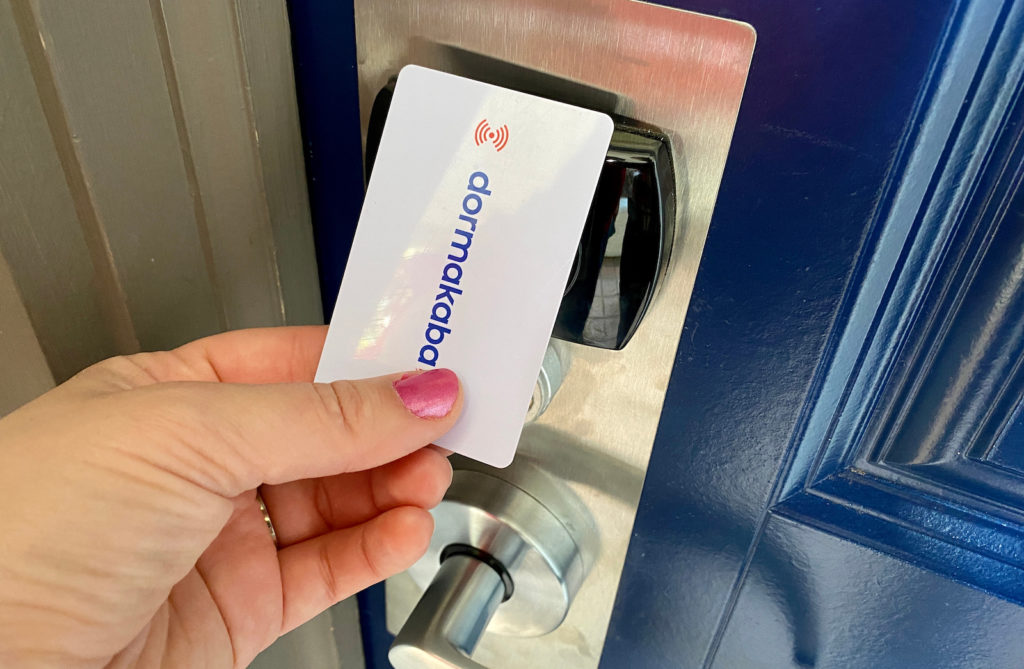
dormakaba is a significant provider of hotel locking systems, offering RFID and mobile access solutions for guest rooms. The lodging business was hit hard by the pandemic (20% below pre-COVID levels in FY 2020/21) but has recovered as hospitality demand returned. dormakaba identifies hospitality as a key vertical for growth alongside airports and healthcare.
Access Hardware & Entrance Automation
The mechanical and automation heritage remains the revenue foundation: door closers, exit devices, mechanical key systems (Access Hardware Solutions), and door operators, sliding doors, revolving doors (Access Automation Solutions). dormakaba also holds a market leadership position in movable walls through its Key & Wall Solutions segment, which contributed CHF 430 million in FY 2024/25 with an adjusted EBITDA margin of 19.7%. The December 2025 acquisition of Avant-Garde Systems, a major US entrance systems control provider, strengthened the North American automation business.
Where does dormakaba sit in the competitive landscape of hardware incumbents and cloud-native challengers?
Memoori’s report analyses the competitive dynamics between traditional door hardware manufacturers and software-first access control platforms.
The North American Growth Push
The most consequential strategic decision dormakaba has made under Till Reuter is the explicit commitment to grow North American revenues aggressively. At its November 2024 Capital Markets Day, the company set a financial ambition to increase North American Access Solutions revenues from CHF 722 million (FY 2024/25) to over CHF 1 billion by 2027/28 — a 39% increase that organic growth alone cannot deliver.
dormakaba has publicly acknowledged that it is a “distant number three” in North America behind ASSA ABLOY and Allegion, both of which have been far more aggressive acquirers in the region for decades. The gap is significant: Allegion generated $4.07 billion in total revenue in 2025 with dominant North American market positions, while ASSA ABLOY’s Americas division is substantially larger than dormakaba’s entire group.
The M&A activity since February 2025 reflects this urgency. Of the 9 deals in 14 months, most have a North American dimension:
- Avant-Garde Systems (Dec 2025) — US entrance systems control products, directly supporting the North American automation business
- TANlock (July 2025) — data centre rack security, leveraging dormakaba’s sales network with a US market focus
- Safetrust (Feb 2025, investment) — mobile credential and identity management, North America-focused
- RealSense (Nov 2025, investment) — AI-powered biometric access, US-based
- SwiftConnect (Feb 2026, investment) — unified mobile and physical credential management, New York-based
dormakaba appears to be at an inflection point. The company has spent several years focused inwards — addressing merger integration, simplifying its product and software portfolio, and building a stronger operational and financial foundation. With Shape4Growth now delivering measurable results and the balance sheet in strong condition, the stage is set for a more active acquisition phase.
Rather than pursuing large, transformative acquisitions that could strain integration capacity, dormakaba has focused on smaller, strategic bolt-on deals that fill specific capability or geographic gaps. This is prudent given the integration history, but the central question is whether bolt-on M&A can close a CHF 278 million gap in three years. The next 12 to 24 months will be telling: dormakaba needs to accelerate deal velocity without repeating the integration challenges of the original merger.
M&A & Investment Timeline

Memoori’s Assessment
Market Position
dormakaba is one of the three most significant traditional access solutions companies globally. The group’s strength lies in its breadth — spanning mechanical hardware, electronic locking, entrance automation, cloud access platforms, lodging systems, key systems, and movable walls — and in its European heritage, with particularly strong positions in the DACH region (Germany, Austria, Switzerland), UK/Ireland, and parts of Asia Pacific. R&D investment of 4–5% of annual sales is above industry averages.
Competitive Positioning
vs. Allegion: Allegion ($4.07B revenue, 2025) is the more direct competitive comparison. Both companies are transforming from mechanical lock heritage into electronic and software-enabled platforms. Allegion’s electronics revenue mix (33% of sales) is substantially ahead, its adjusted operating margin (23.2%) is significantly higher, and its North American market position is far stronger. Allegion’s $50M Allegion Ventures CVC unit and larger acquisition budget ($630M in 2025) give it more tools for technology-driven growth. dormakaba’s advantages are European market depth, the broader product range (entrance automation, movable walls), and lodging systems strength.
vs. Cloud-Native Platforms: Brivo, Verkada, and other cloud-native access control companies present a different kind of challenge. Their subscription-based, panel-free, IT-managed model is gaining share in the small-to-medium commercial market where dormakaba’s exivo and resivo platforms compete. dormakaba’s cloud platforms are functional but lack the integrations ecosystem and developer community that purpose-built cloud access platforms have created. The SwiftConnect investment suggests dormakaba recognises the need for open, manufacturer-independent credential management, but integration rather than disruption remains the approach.
vs. Honeywell (LenelS2): Honeywell competes at the enterprise PACS software layer (OnGuard, NetAXS), a segment where dormakaba interacts primarily as a hardware provider. dormakaba’s products integrate with LenelS2 and other enterprise systems through standard interfaces, positioning dormakaba as a component supplier rather than a platform competitor in the enterprise segment.
dormakaba is the most interesting strategic story among the three traditional access solutions giants precisely because the outcome is least certain. ASSA ABLOY’s market leadership is entrenched. Allegion’s pure-play model is delivering high margins and steady digital transformation. dormakaba is the one that needs to prove it can shift from a historically cautious acquirer to a more assertive consolidator while simultaneously completing its internal transformation.
The Shape4Growth results are encouraging — exceeding cost savings targets, expanding margins, simplifying the portfolio. The M&A acceleration under Till Reuter is real — 9 deals in 14 months after years of relative inactivity. And the CHF 1 billion North American target gives the market a clear metric to judge execution against. But the gap with ASSA ABLOY and Allegion remains substantial, and the window for building scale in physical access control before cloud-native platforms reshape the competitive landscape is not unlimited. dormakaba has the foundation, the brands, and the balance sheet. The next 24 months will determine whether it has the execution speed. For the full competitive landscape, see Memoori’s comprehensive report.
Get the Full Market Picture
This dormakaba assessment covers one company. Memoori’s 2025 report covers the entire $15.1 billion global physical access control market — hardware, software & credentials — with company classifications, M&A tracking, and forecasts through 2030.
Frequently Asked Questions
Related Company Strategies
Methodology: This analysis draws on Memoori’s The Physical Access Control Business 2025 to 2030, dormakaba’s Annual Report 2024/25, Half-Year Report 2025/26, Capital Markets Day presentations, SIX Swiss Exchange filings, and third-party reporting from industry publications. Research methodology includes vendor classifications across 273 companies, market sizing across hardware, software & credentials, M&A tracking, and competitive positioning assessment. Memoori does not accept vendor payment for inclusion or ranking. For the full methodology, see our Research Methodology page.