For years, most of the innovation in HVAC optimization came from small software firms selling to the few building owners willing to experiment. That is changing quickly.
In less than two years, the companies that make the chillers, air handlers, and controls inside commercial buildings have bought their way into the software category. Investors have meanwhile put fresh money into the specialists that remain independent.
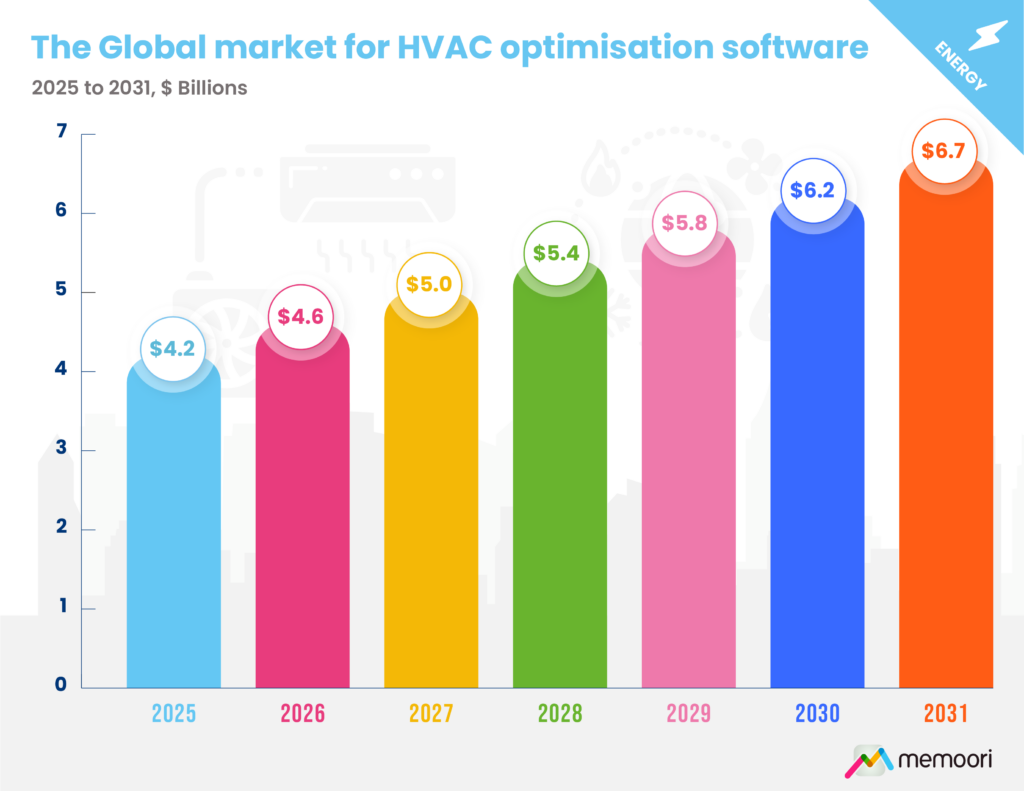
Memoori’s new research, HVAC Optimization in Commercial Buildings 2026 to 2031, puts global revenue for HVAC optimization software at $4.6 billion in 2026, rising to $6.7 billion by 2031. That is steady rather than spectacular growth, at about 8.1% a year from a 2025 base of $4.2 billion. Behind the headline number, though, the shape of the market is changing fast.
Seven Acquisitions in 19 Months
Since our 2024 edition, we have tracked seven acquisitions involving HVAC optimization, made between December 2024 and July 2026. Including:
- Trane Technologies – BrainBox AI (completed January 2025): autonomous, AI-based HVAC control, building on an existing partnership.
- Copeland – Bueno Analytics (agreed January 2026): analytics and predictive maintenance across HVAC and refrigeration.
- Johnson Controls – Nantum AI (April 2026): occupancy-responsive airflow optimization for the OpenBlue platform.
- Carrier – 75F (July 2026): cloud-native, wireless controls aimed at light commercial and retrofit buildings.
It is tempting to read this as a single AI story, but it isn’t. Each buyer filled a different gap. Nantum gives Johnson Controls air-side optimization to sit alongside its central plant tools. 75F gives Carrier a way into smaller buildings, where conventional BMS are rarely installed. Bueno moves Copeland from selling equipment toward recurring software revenue across HVAC and cold chain.
The common thread is that equipment makers want a share of the recurring revenue from running equipment, not just from selling it. For independent vendors, that changes the competition. Partnerships with integrators and service firms will matter as much as the quality of the algorithm.
Investors have been Backing Autonomy
We tracked 29 funding deals involving 27 companies between October 2024 and October 2026. The five largest all went to US-based firms: PassiveLogic ($74m Series C), Runwise ($55m Series B), Phaidra (more than $50m Series B), 75F ($45m, months before Carrier bought it), and GridPoint ($45m). Outside the US, the largest round was aedifion’s Series B of roughly €17m in Germany.
Most of these rounds are earmarked for geographic expansion. In practice, that means well-funded vendors are now heading into each other’s home markets.
A Crowded Field with a Missing Middle
Our 2026 listing covers 126 HVAC optimization vendors. Europe is home to 60 of them and the Americas to 51. The US alone has 46, more than Germany, France and the UK combined.
The size profile is lopsided. About three-quarters of these vendors have 250 or fewer employees, while 21 are corporate groups with more than 10,000. Very few sit in between. Markets shaped like this, with many small specialists and a handful of giants able to buy them, usually see more consolidation. We expect the deal flow to continue.
Data Centers Punch Above Their Weight
Data centers take a far larger share than their floor area would suggest. The International Energy Agency reports that data center electricity demand grew 17% in 2025. Cooling can take about 7% of a data center’s power in the most efficient hyperscale sites and more than 30% in less efficient enterprise facilities. The best opportunity for vendors lies with colocation and enterprise operators that lack the in-house controls teams of the big cloud providers.
HVAC Optimization: Most Buildings Still at “Level 1”
Most commercial buildings still sit at the bottom of our four-level capability scale. They run on schedules, setpoints, and basic alarms, with people deciding what to change.
Moving up a level is mostly integration work, not a new software license. In one Oak Ridge National Laboratory field study, two-thirds of the labor spent deploying model predictive control (software that forecasts how a building will respond and plans the settings ahead) went into building, debugging, and tuning the model.
Owners face other hurdles too: split incentives between landlords and tenants, IT security reviews, ageing controls and a shortage of skilled operators. That is why we forecast steady rather than explosive growth.
The full HVAC optimization software market report runs to 290 pages. It includes forecasts by region and vertical to 2031, profiles of the leading building automation firms, HVAC Optimization specialists, and startups, and an Excel datasheet of all 29 investment deals. It is also included in Memoori’s Enterprise Subscription.
Join the live discussion! We will present the findings in a 30-minute live session, HVAC Optimization: The ROI Lever Building Owners Should Be Pulling, on Wednesday, 11th November at 1530 CET, streamed on LinkedIn.