

This new 2026 study sizes the global HVAC optimization software market, forecasts it to 2031 by region and vertical market, and maps the 126 companies competing for it.
HVAC optimization has moved from a sustainability project to an operating-cost priority. Heating, ventilation and cooling account for just over half the energy used in US commercial buildings, and most of those buildings still run on fixed schedules and static setpoints. Software that finds faults, recommends fixes and, increasingly, adjusts equipment itself is the cheapest lever owners have.
This report examines energy management software for HVAC optimization in offices, retail, data centers, hospitality, venues, warehouses, and mixed-use buildings. It explains how the technology works, from rule-based fault detection to AI-driven autonomous control. It also weighs the measured field evidence on savings against vendor claims and sets out why deployment is often harder than the sales pitch suggests.
The report includes, at no extra cost, an Excel datasheet with the data behind the charts, the company listing, and the full record of 29 investment deals, together with presentation-ready slides of every chart. This is the first of two related reports. Its sister study, on building-to-grid interaction software, follows shortly. Both reports are included in Memoori’s 2026 Premium Subscription, which also gives access to our AI Services.
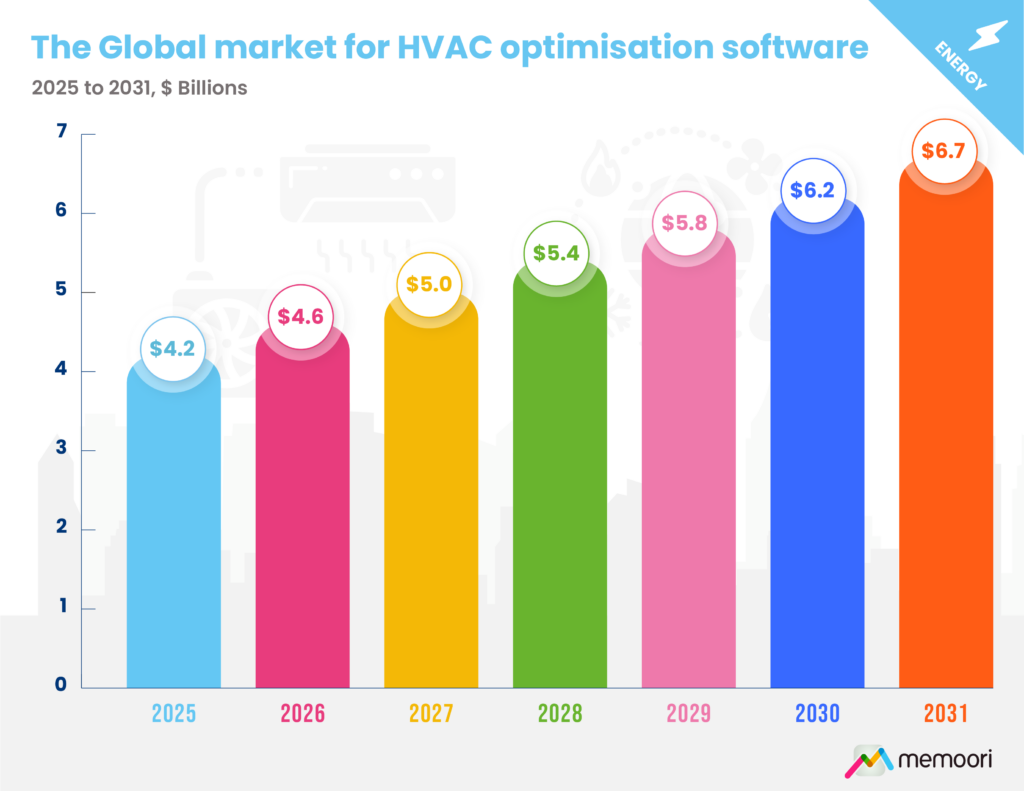
HVAC Optimization Market Size & Forecast
Memoori estimates the global market for HVAC optimization software at $4.6 billion in 2026, rising to $6.7 billion by 2031. From a 2025 base of $4.2 billion, that is growth of about 60%, a compound annual growth rate (CAGR) of roughly 8.1%. The estimate is built bottom-up from the revenue of the companies we track.
Growth is driven by energy-cost pressure, regulation of building controls, sustainability reporting and green finance. It is held back by split incentives between owners and tenants, integration with legacy controls, and skills shortages. The report sets out what would push the forecast higher or lower.
HVAC Optimization Software: Research Scope
This report focuses on next-generation software that uses artificial intelligence (AI), the Internet of Things (IoT), and other analytical methods to track, analyze, automate and optimize HVAC energy use and performance. In scope:
- Software that directly supports HVAC automation and optimization, including actionable recommendations
- HVAC-related energy performance and carbon reduction
- Automated HVAC fault detection and diagnostics (FDD)
- Data integration and interoperability integral to HVAC optimization
- Seasonal and weather-driven optimization
- Occupancy-based HVAC control
Out of scope are non-HVAC energy management, standalone energy reporting and visualization, HVAC equipment, IoT hardware and basic controls, installation and consulting, standalone ESG reporting, and building-to-grid functions, which the sister report will cover. Residential, industrial, healthcare, and education buildings are also excluded.
WITHIN ITS 290 PAGES AND 13 CHARTS, THE REPORT FILTERS OUT THE KEY FACTS AND DRAWS CONCLUSIONS, SO YOU CAN UNDERSTAND EXACTLY HOW THE HVAC OPTIMIZATION MARKET IS SHAPED TODAY AND HOW IT WILL DEVELOP:
- Data centers punch far above their weight. They account for 12.3% of HVAC optimization revenue in 2026, far more than their floor area suggests. Cooling follows IT load; data center electricity demand grew 17% in 2025 (IEA), and the biggest opportunity lies with colocation and enterprise operators rather than the hyperscalers.
- Building technology majors are buying AI specialists. Trane acquired BrainBox AI, Johnson Controls bought Nantum AI and Webeasy, Carrier bought 75F, Copeland agreed to buy Bueno Analytics, and ABB acquired Eliona’s platform.
- Investors are backing autonomy. We tracked 29 funding deals between October 2024 and October 2026. The largest were PassiveLogic ($74m), Runwise ($55m), Phaidra (over $50m), 75F ($45m) and GridPoint ($45m).
- The vendor base splits between startups and giants. Of 126 vendors, about three-quarters have 250 or fewer employees and 21 have more than 10,000, with few in between. We expect more partnerships and acquisitions to fill that gap.
For only $3,000 USD this report gives vendors, investors, and building owners the market sizing, forecasts, and competitive intelligence they need to plan strategy and judge where the HVAC optimization opportunity is largest.
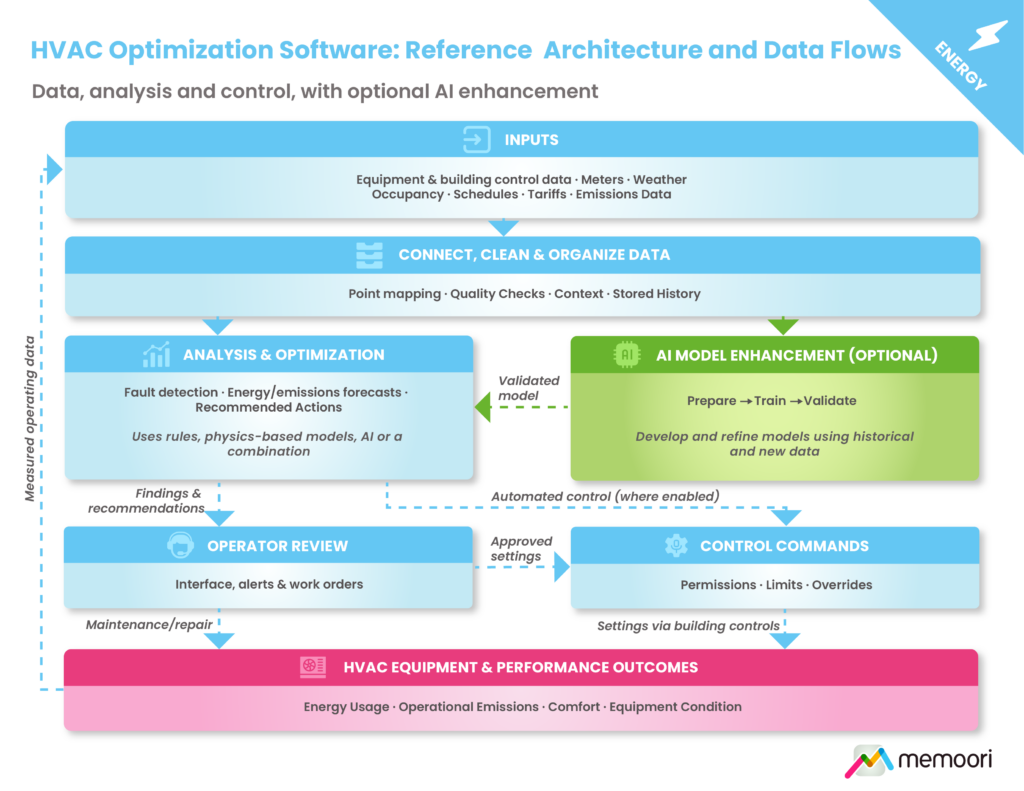
The infographic above shows how data flows through HVAC optimization software. Inputs such as controls data, meters, weather, occupancy and tariffs are connected, cleaned and mapped. They are then analyzed using rules, physics-based models, AI or a combination of these.
The resulting findings go to operators as alerts and work orders. Where automated control is enabled, the software sends commands to the building’s controls within agreed limits. Measured outcomes feed back into the next decision, which is how AI HVAC optimization improves over time.
WHO SHOULD BUY?
The report will be of value to anyone who builds, sells, buys or invests in HVAC optimization and energy management software for commercial buildings. That includes software vendors, HVAC and controls manufacturers, systems integrators and service providers, along with investors, private equity firms and corporate development teams.
Building owners, REITs, property and facilities managers, and their advisors will also find practical guidance on field evidence, commercial models and the questions to ask before they buy.
Table of Contents
- Research Scope
- Methodology
- Definitions
- Part I. Market Structure, Technology and Adoption
- 1. Market Definition, Structure and Value Chain
- 2. Technology, AI and Control Capabilities
- 3. Adoption, Installed Base and Market Maturity
- Part II. Applications and Customer Value
- 4. Use Cases, Measured Performance and Customer Economics
- 5. Vertical Markets and Deployment Opportunities
- Part III. Demand Drivers and Delivery Barriers
- 6. Market Drivers, Policy and Purchasing Triggers
- 7. Procurement, Deployment and Operational Barriers
- Part IV. Market Size and Outlook
- 8. Global Market Size and Forecast
- 9. Regional and Vertical Market Breakdown
- Part V. Competition, Investment and Strategic Direction
- 10. Competitive Landscape and Supplier Ecosystem
- 11. Strategic Positioning of Key Companies
- 12. M&A, Funding and Strategic Shifts
List of Charts & Figures
- Fig 2.1 – HVAC Optimization Software: Reference Architecture and Data Flows
- Fig 3.1 – Building Energy Demand: Overall Building Energy Demand 2024
- Fig 3.2 – Major Fuels Consumption by End Use in US Commercial Buildings 2018
- Fig 3.3 – HVAC Optimization Capability Levels
- Fig 8.1 – The Global Market for HVAC Optimization Software to 2031, $ Billions
- Fig 9.1 – HVAC Optimization Software Revenue by Region to 2031, $ Billions, % of Total
- Fig 9.2 – Building Energy Use by Region 2010 to 2024
- Fig 9.3 – HVAC Optimization Software Revenue by Market Vertical 2026, $ Millions
- Fig 10.1 – Distribution of HVAC Software Companies by HQ Location
- Fig 10.2 – Distribution of HVAC Optimization Software Companies by Company Size, Number of Employees
- Fig 10.3 – Distribution of HVAC Software Companies by Company Age
- Fig 10.4 – HVAC Optimization Stakeholders: Priorities and Solution Requirements
HVAC Optimization Software Companies Mentioned INCLUDE (but NOT limited to)
75F | ABB | Accenta.ai | Acuity | aedifion | AGRID | Akila | Albireo Energy | Amey | Artis Energy | Arup | Axiom Cloud | Azbil | Azendian Solutions | BeeBryte | Bisly | Bosch | BOSS Controls | BrainBox AI | Bueno Analytics | C3 AI | Carrier | CBRE | CIM | Cimetrics | ClevAir | Climaid | Clockworks Analytics | CloudN | Cognizant | CopperTree Analytics | Cortex Building Intelligence | Dabbel AI | Daikin | Dalkia UK | Danfoss | Demand Logic | DiLT Analytics | Dnergy | ecoDriver | Ecolibrium | Ecopilot | Eficia (formerly Eco GTB) | EkkoSense | Elexity | Encycle | Enerbrain | EnergyWise (Foobot) | Enersee | Enertiv | ENFRA | Ento Labs | Entronix | Equans | etalytics | Exergenics | Exergio | facil.ai | Facilio | Flowbox | Fluix AI | GlacierGrid | Grid Edge | GridDuck | Gridium | GridPoint | Hero Balancer | Honeywell Technologies | IBM | INGINIR (formerly inteliGlas) | JLL | Johnson Controls | Joulea | Kieback&Peter | KODE Labs | Logical Buildings | mCloud | Metr Building Management Systems | METRON | Mitsubishi Electric | monaire | Mondas | MRI Software | Myrspoven | Nantum AI | Noda (formerly Infogrid) | Nordomatic | Octopus Lab | Optimise AI | Optimum Energy | Oxoia | Parity | PassiveLogic | Phaidra | Phoenix Energy | Pointguard | Powerhouse Dynamics | Preflet | Priva | PropTechOS | R8 Technologies | REC Green Technologies | Recognizer | Rensair | RESync | Runwise | R-Zero | Sally R | Schneider Electric | Sensgreen | SensorFlow | Shift Energy | Siemens | SkyFoundry | Small Box Energy | Smarkia | Smartwatt | Solwena | Spacewell | Spectral Enterprise B.V. | SPIE | Thermosphr | TheWatchDog | Trane Technologies | Verdigris Technologies | Vertiv | viboo | Vigilent | vilisto GmbH | Wia | Willow | xWatts
DOWNLOAD THE BROCHURE OR CONTACT US DIRECTLY TO DISCUSS ALTERNATIVE PAYMENT OPTIONS