

This Report is the Definitive Evidence-Based Resource for Understanding Where AI is Genuinely Transforming Commercial Buildings, and Where it is Not
The AI story in commercial buildings is more complicated than the headlines suggest. While corporate AI investment reached $252.3 billion globally in 2024, and survey data shows 92% of commercial real estate organizations are now piloting or planning AI, the conversion to meaningful results has been startlingly poor: fewer than 5% report achieving most of their AI program goals.
This is the third edition of Memoori’s analysis of artificial intelligence in smart commercial buildings, extending editions published in 2021 and 2024. It is the first in a two-part series. This volume examines market dynamics, technology foundations, use cases, and the opportunity landscape.
The research draws on program evaluations from NYSERDA, NREL, LBNL, and the DOE; peer-reviewed academic research; industry surveys; and systematic analysis of vendor case studies assessed against an explicit evidence-grading framework that distinguishes independently verified outcomes from vendor claims. This report is included in our 2026 Enterprise Subscription Service.

Why This Research Matters in 2026?
- The most under-appreciated barrier to commercial buildings AI is neither the sophistication of available models nor the cost of cloud infrastructure; it is the cost and complexity of integrating AI with the existing building stock. In documented deployments, up to 75% of engineering effort and budget goes to making existing systems legible to the analytics layer, not to the analytics itself.
- Vendor transparency is a persistent and worsening problem. Vendor-reported energy savings commonly cite 20–50%, while portfolio-scale independent evaluations consistently converge on 3–15%. NYSERDA’s real-time energy management program, covering 654 sites, found a realization rate of just 48% against vendor-reported figures. This report grades every performance claim accordingly.
- A new and largely overlooked risk has emerged on the insurance side. From January 2026, standardized ISO endorsements introduce absolute AI exclusions covering bodily injury, property damage, and personal injury arising from machine-learning systems. Because hundreds of US carriers use ISO forms as their baseline, the more autonomous control a building operator grants to AI, the wider their coverage gap becomes.
- The cost picture is bifurcating sharply. AI inference costs dropped approximately 280-fold between 2022 and 2024, making software deployments more accessible. But sensor prices are up 45.6%, BAS controllers up 35.2%, and networking equipment up 32.7% since 2018, meaning the path to AI-readiness still costs more than ever for most of the commercial buildings stock.
69 AI Use Cases Assessed Across 12 Application Domains
This report identifies 69 distinct use cases where AI is being actively developed or commercialized for the smart buildings market, organized across 12 application domains.
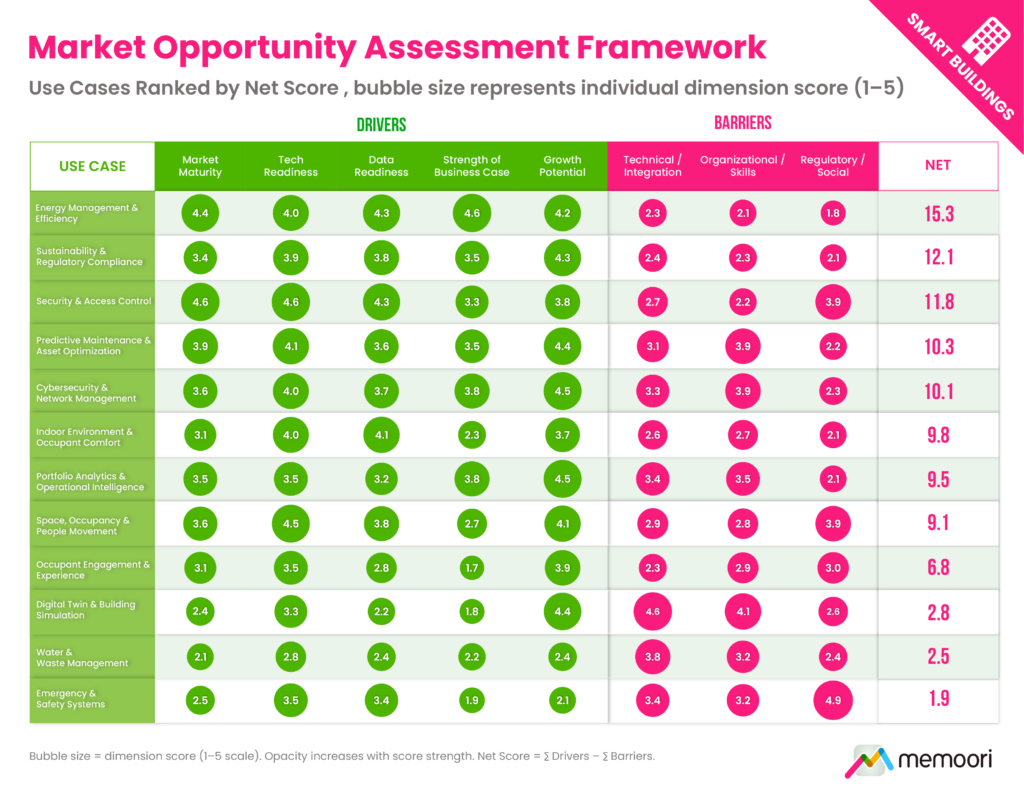
Each domain is evaluated using an eight-dimensional scoring framework, which you can see below, covering five positive market drivers (market maturity, technology readiness, data readiness, strength of business case, and growth potential) offset by three barrier categories (technical and integration, organizational and skills, and regulatory and social barriers).
Energy Management & Efficiency
Energy management is the only domain in the top deployment tier, scoring 15.3 out of 20. But even here, the evidence reveals a critical hierarchy of outcomes. Passive dashboards deliver around 2–3% energy savings; fault detection and diagnostics around 9%; and autonomous supervisory optimization achieves verified electric savings of approximately 12–13% in independently evaluated programs. The distinction between alerting a facilities manager to a fault and autonomously correcting it is not marginal; it is order-of-magnitude.
An important counter-intuitive finding from the independent evidence base is that smaller commercial buildings consistently outperform larger ones under rigorous evaluation, suggesting that light commercial buildings, historically underserved by sophisticated vendors, may represent a disproportionate near-term opportunity.
The energy management domain is also expanding to encompass grid-interactive commercial buildings, virtual power plants, EV charging integration, and, critically, automated measurement and verification, which is becoming a strategic battleground determining who controls the source of truth for energy savings claims.
Deployment Outlook: Three Phases Through 2031
The report identifies a three-phase deployment pattern gated not by AI model capability, but by data readiness, semantic interoperability, governance, and commercial model maturity:
- Phase 1 (Now — 12 months): Copilot and analytics deployment. Natural language interfaces, reporting automation, and fault triage in well-instrumented buildings. Competitive differentiation comes from the depth of workflow integration, not the underlying model.
- Phase 2 (12–36 months): Portfolio-scale supervisory optimization, enabled by semantic interoperability standards, like ASHRAE 223P. Building performance standard enforcement is the primary demand driver.
- Phase 3 (36–60 months): Bounded autonomy in specific subsystems. Closed-loop AI control in central plant and mechanical systems where instrumentation is robust, and savings are directly measurable.
The mass-market problem for smaller buildings, roughly 94% of the US commercial buildings stock by count, remains structurally unsolved during the forecast period. Whether the market reaches its potential faster will depend less on algorithmic advances than on data infrastructure, delivery model innovation, and the industry’s willingness to meet the rigorous evaluation standards that buyers are increasingly demanding.
Who Should Buy This Report?
This research will be valuable to:
- Commercial Buildings owners and operators seeking to understand where AI investment is genuinely justified, how to sequence deployment, and how to evaluate vendor claims against independent evidence.
- Technology vendors and solution providers who need to understand where buyer readiness, regulatory pressure, and competitive dynamics are creating the most defensible near-term opportunity.
- Commercial Buildings systems manufacturers assessing how AI capability is becoming embedded in hardware categories and where the integration layer battleground is moving.
- Investors (VCs, PE firms, corporate VC arms) evaluating where in the smart buildings AI stack durable value is being created and where the current market structure is likely to consolidate further.
- Corporate real estate and facilities management teams navigating the pilot-to-scale gap and seeking an independent framework for prioritising AI investment across their portfolios.
- Smart building consultants and system integrators who need a current, evidence-based map of the use case landscape to inform client advisory work.
The research is provided as a PDF report with 69 use case assessments, an original energy savings evidence analysis, and Appendix A: the full cross-source evidence dataset. Priced at $3,000 USD for an Enterprise-Wide License. Individual subscribers receive a 10% discount. Want to know more? Download the Brochure.