
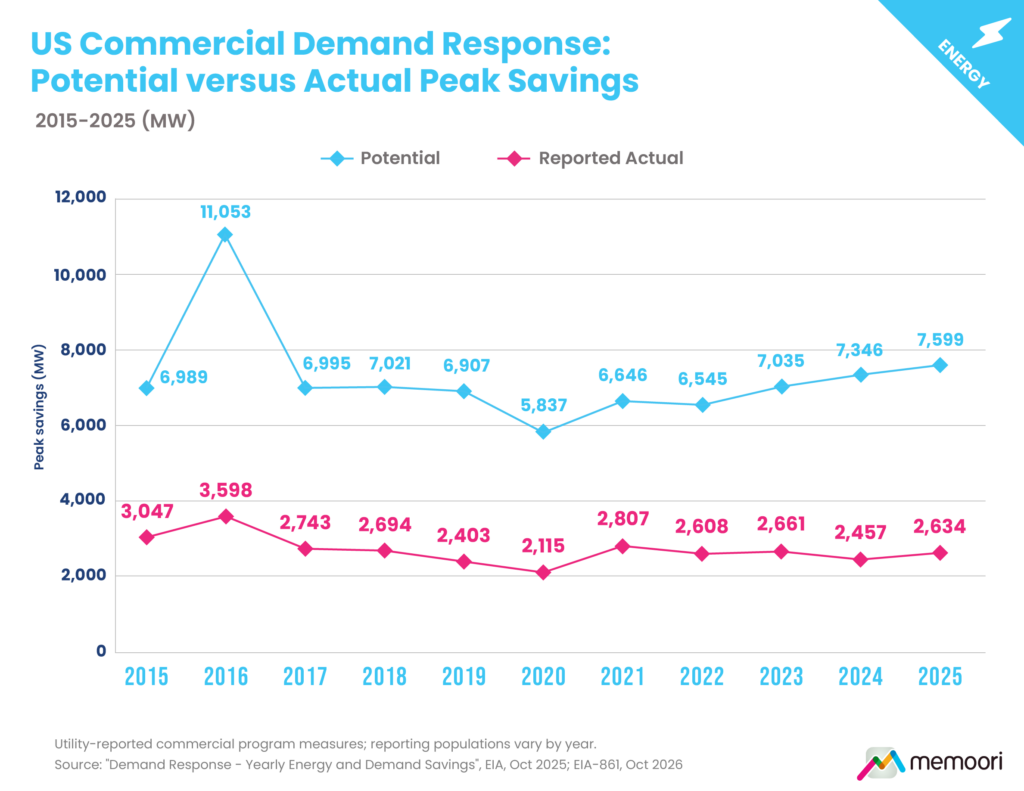
Grid-interactive buildings could be among the cheapest power stations the grid has, yet most of their capacity is never switched on. In 2025, utility demand response programs for US commercial customers had the potential to cut 7,599 megawatts (MW) of peak demand. They delivered 2,634 MW, according to the US Energy Information Administration (EIA). Roughly two-thirds of the flexibility on offer was left on the table.
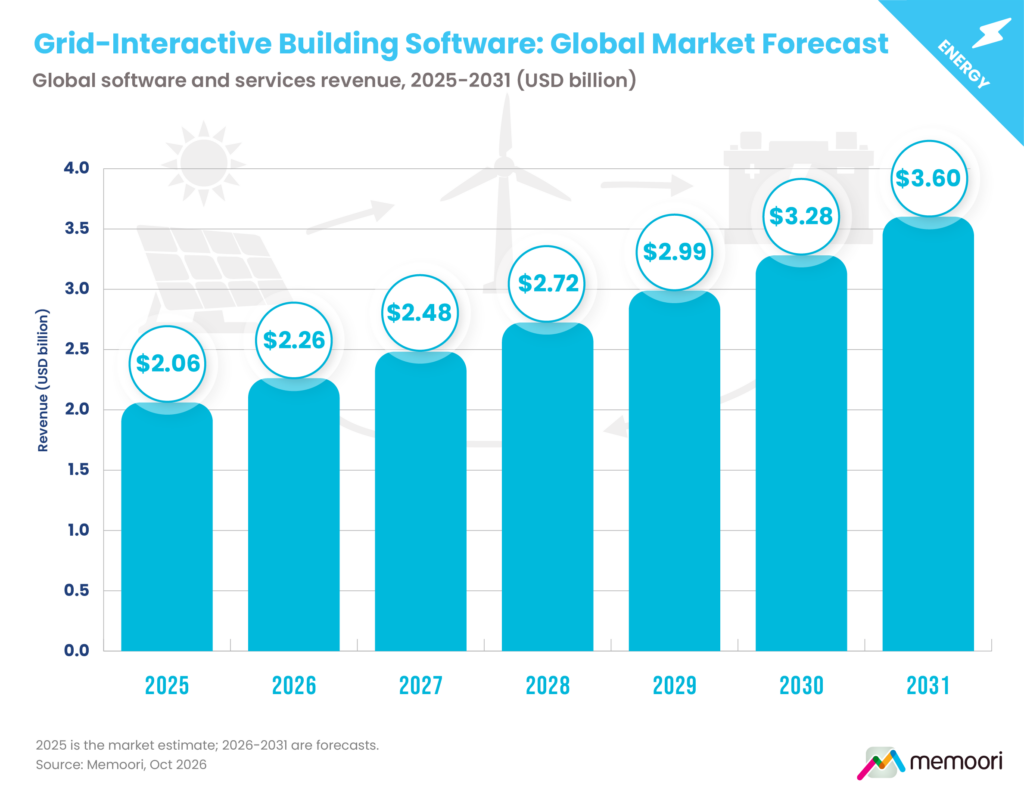
That gap is the clearest sign yet that grid-interactive buildings are a software problem as much as a hardware one. Memoori’s new report, Grid-Interactive Buildings Software Market 2026 to 2031, sizes the market, forecasting it to close at $2.06 billion in 2025, rising to $3.60 billion by 2031, and maps the 237 companies competing for it.
A decade of standing still
The performance gap in grid-interactive buildings is not new. Apart from a spike in 2016, potential peak savings from US commercial programs have sat between about 5,800 MW and 7,600 MW for a decade. Delivered savings have barely moved, staying between about 2,100 MW and 3,600 MW.
What has changed is the direction of travel. Potential has risen every year since 2022, from 6,545 MW to 7,599 MW. Actual savings went from 2,608 MW to 2,634 MW over the same period. The opportunity is growing. Delivery is not keeping up.
Why grid-interactive buildings underdeliver
In our analysis, four problems hold buildings back.
- Response is still manual. Many programs rely on a facilities manager getting an alert and turning equipment down by hand. If nobody acts, nothing happens.
- Owners cannot forecast what they can give. Utilities pay for load reduction measured against a baseline. A building that cannot predict its own demand tends to commit to less than it could deliver, to avoid penalties.
- Systems do not talk to each other. Heating, ventilation and air conditioning (HVAC), lighting, batteries and electric vehicle (EV) chargers often run on separate controls from separate vendors. No one platform is orchestrating them together.
- Comfort comes first. Owners will not risk tenant complaints for a modest grid payment. Without confidence that a response will stay within comfort limits, they opt out.
Each of these is a software problem, and software for grid-interactive buildings is now tackling all four.
Software is the missing layer
Grid-interactive buildings need four things working together: connectivity to their equipment, forecasting of load and prices, automated control, and a link to the grid operator or aggregator that pays for flexibility.
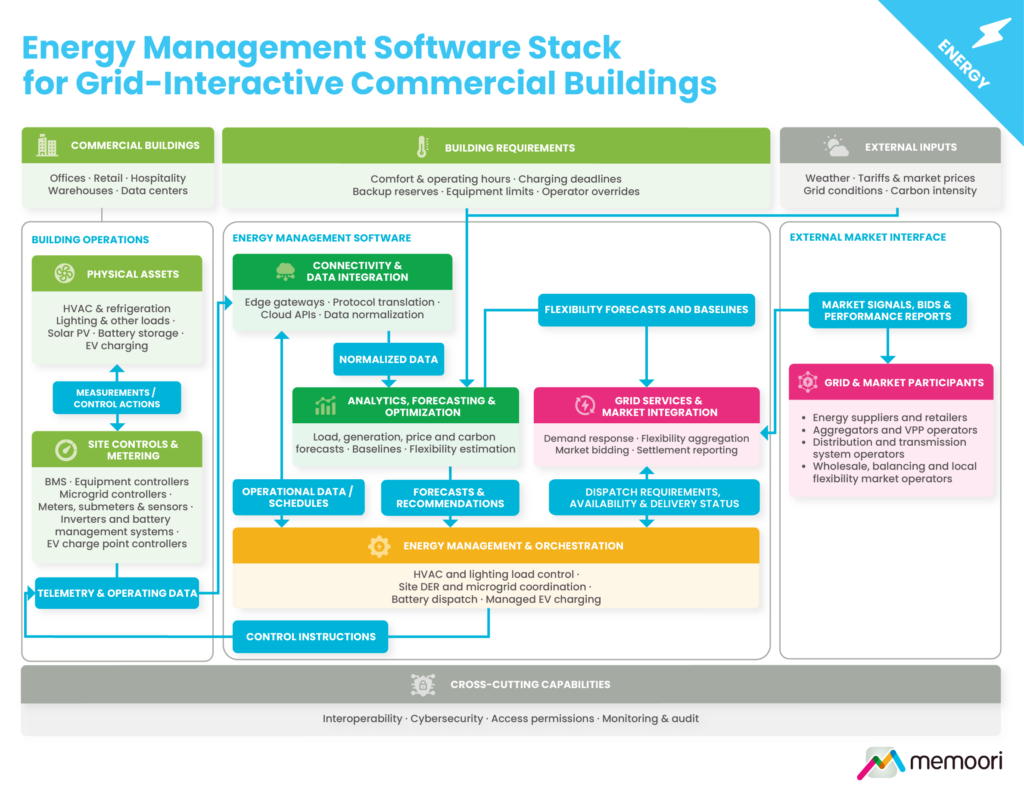
Picture a 20-story office on a hot afternoon. At 2pm, the platform sees a grid peak coming. It pre-cools the floors while power is cheap, then eases back on cooling at 4pm. The on-site battery discharges, EV chargers in the garage pause, and lighting dims slightly in unoccupied zones. Tenants barely notice. The platform then sends proof of delivery to the aggregator, and the building gets paid.
None of those steps needs new hardware in most modern buildings. It needs software that can see, predict and act. That software layer is what separates grid-interactive buildings from merely passive ones.
The prize: from 28 GW to 161 GW
The stakes are about to rise sharply. The International Energy Agency (IEA) expects demand response from buildings worldwide to grow from around 28 gigawatts (GW) in 2024 to about 161 GW by 2035 under its Stated Policies Scenario. By then, buildings would provide 46% of peak demand response and nearly 60% of daily flexibility.
The drivers are familiar: more wind and solar on the grid, the electrification of heating and transport, and fast-rising electricity demand from data centers. Grid operators need demand that can bend, and grid-interactive buildings are among the largest, most controllable loads they can reach.
A $3.6 billion market, and 237 companies chasing it
Our report forecasts that global software and services revenue for grid-interactive buildings will grow from $2.06 billion in 2025 to $3.60 billion by 2031, a compound annual growth rate (CAGR) of 9.7%. That figure counts software and services only, not batteries, chargers, or meters.
We identified 237 companies competing for that revenue. They range from energy majors such as Enel X, ENGIE and E.ON, to building automation giants including Schneider Electric, Siemens, Johnson Controls and Honeywell, to specialists such as Voltus, CPower and GridBeyond.
Money is following. The IEA puts global venture capital in virtual power plants (VPPs) and distributed energy resource management systems (DERMS) at $649 million in 2025. Since October 2024, we have logged 25 funding events across 23 companies, including Voltus’ $225 million Series D, Emerald AI’s $150 million Series A, and Budderfly’s expanded debt facilities for its energy-as-a-service model.
What it means for owners, vendors and investors
Building owners should ask a simple question: is our flexibility automated, or does it depend on someone reading an email? Owners with batteries, EV chargers or modern controls may already run grid-interactive buildings in all but name, with a revenue stream they are not collecting.
Vendors face a crowded field. Dashboards are no longer enough. The winners will be those that can prove delivery, connect to equipment from many manufacturers, and keep tenants comfortable. With 237 players, we expect consolidation.
Investors should watch the gap between potential and actual savings. The companies that narrow it, measurably, are the ones turning grid-interactive buildings from a promise into a business.
Read the full analysis. Grid-Interactive Buildings Software Market 2026 to 2031 includes the five-year forecast by application and region, the full competitive landscape of 237 companies, investment and M&A trends, 18 charts, and an Excel datasheet. Its sister study on HVAC Optimization software is available now. Both are included in Memoori’s 2026 Premium Subscription.