
Hanwha Vision Video Surveillance Strategy: An Independent Assessment
The NDAA-compliant South Korean challenger that crossed $1 billion in revenue, built its own AI silicon, and is capturing the Western market share that Chinese vendors are losing.
From The Global Video Surveillance Business 2025 to 2030The Strategic Picture
Hanwha Vision is a South Korean video surveillance company that has transformed from a mid-tier camera manufacturer into one of the five largest players in the global market. The company entered the video security business in 1990, spent two decades building competence in optoelectronics and network cameras, and has accelerated sharply since geopolitical restrictions began closing Western markets to Chinese competitors from 2019 onwards.
Hanwha Vision is part of the Hanwha Group, one of South Korea’s largest conglomerates with interests spanning defence, aerospace, financial services, and energy. In September 2024, the video surveillance business was spun off from Hanwha Aerospace to operate independently. On 1 January 2025, Hanwha Vision completed a merger with Hanwha Industrial Solutions and debuted on the Korean stock exchange (KRX: 489790), gaining direct access to public capital markets to fund R&D and global expansion.
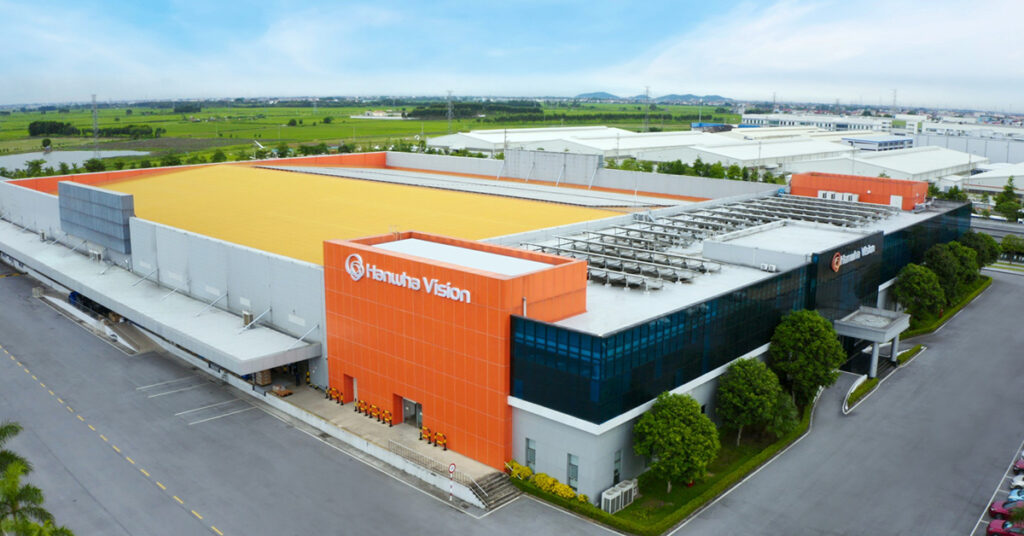
In 2024, Hanwha Vision reported revenue of KRW 1.215 trillion (over $1 billion), up 16.1% year-over-year. Operating profit reached KRW 170 billion (+10.7%), and pre-tax profit hit KRW 189 billion (+28.2%). The Americas account for approximately 50% of total revenue (~$519 million), with European sales contributing ~$134 million (13%) and growing at 18.9%. The company operates through 5 subsidiaries and 15 branch offices, with production facilities in South Korea and Vietnam and 2,530 employees worldwide.
Memoori’s 2025 Global Video Surveillance report classifies Hanwha Vision in Group A — the top tier of global vendors alongside Hikvision, Dahua, Canon/Axis, and Motorola Solutions. This represents a significant upgrade, reflecting sustained scale and double-digit expansion. In the Americas, Hanwha Vision ranks as the third-largest player with 7.5% market share, up from just 0.8% fourteen years ago — a compound annual growth rate of 14%. Major clients include nine of the top ten US banks, Walmart, Tesla, and TJX.
The NDAA Compliance Advantage
Hanwha Vision’s growth story is inseparable from the regulatory exclusion of Chinese surveillance vendors in Western markets. NDAA Sections 889 and 5949 prohibit US federal agencies from procuring equipment from Hikvision, Dahua, and other designated Chinese manufacturers. The FCC Covered List and Commerce Department Entity List extend these restrictions further. Canada ordered Hikvision Canada to wind up operations in June 2025. The UK, Netherlands, Australia, and Lithuania have implemented their own removal programmes. India’s 2025 national security testing regime mandates firmware and source code audits for CCTV hardware.
Hanwha Vision has positioned itself as the primary beneficiary of this bifurcation. The company manufactures in South Korea and Vietnam, qualifying its products for TAA and GSA procurement. Its entire professional portfolio is NDAA-compliant, and it holds FIPS 140-3 Level 3 security certification — the highest available for commercial surveillance equipment. The company actively markets origin assurance, cybersecurity transparency, and supply chain traceability as core differentiators.
The compliance tailwind is real and structural, not cyclical. Every new government removal programme — every rip-and-replace contract — generates demand that flows disproportionately to NDAA-compliant vendors. Hanwha Vision, Axis Communications, and Motorola Solutions are the three largest recipients of this demand. Hanwha’s advantage over Axis in price-sensitive government bids, and over Motorola in deployments where radio integration is not required, gives it a distinctive lane in a growing replacement market that Memoori estimates will sustain demand growth well beyond 2030.
Product Portfolio and AI Strategy
Wisenet 9: Proprietary AI Silicon
The launch of the Wisenet 9 AI-native System on Chip (SoC) in April 2025 marked a strategic inflection point. Wisenet 9 features a dual Neural Processing Unit (NPU) architecture — one NPU dedicated to AI-based image processing (wide dynamic range, noise reduction, sharpening), the second to object detection and analytics (people counting, vehicle classification, Re-ID tracking, slip/fall detection, crowd detection, queue management, AI sound classification for gunshots, glass breaks, and screaming). This separation ensures that analytics workloads never degrade image quality.
Wisenet 9 delivers 3x the inference performance of the previous Wisenet 7 generation and up to 50% bandwidth reduction through H.265 compression. Among major surveillance vendors, only Hikvision (HiSilicon), Axis (ARTPEC-8), and now Hanwha Vision control their own edge AI silicon — a strategic capability that determines how quickly a vendor can iterate on analytics features without dependence on third-party chipset roadmaps.
In May 2026, Hanwha signed a long-term agreement with Ambarella worth over $800 million in potential revenue over more than ten years — one of the largest partnerships in Ambarella’s history. The deal covers co-development and deployment of current and next-generation edge AI SoCs and software across Hanwha’s expanding portfolio, spanning video security, robotics, industrial automation, and life sciences. Ambarella’s CVflow AI accelerator architecture — with an installed base of over 46 million units and 12 edge AI SoCs delivering up to hundreds of TOPS of inference performance — will complement Hanwha’s proprietary Wisenet silicon, giving the company a dual-source AI chipset strategy that reduces supply chain risk while accelerating product development across multiple industries.
Camera Portfolio
Wisenet 9 powers two flagship camera lines. The X-series AI (second generation) is the premium tier, with six models currently shipping: dome, bullet, and vandal-resistant variants in 8MP and 9MP configurations. The P-series AI targets mid-range deployments with edge AI object classification. Both lines support dynamic privacy masking, Re-ID for cross-camera person tracking, BestShot targeted object capture, and three independently adjustable streams for metadata, analytics, and image enhancement. A new ruggedised PTZ (TNP series) extends the Wisenet 9 platform to harsh outdoor environments.
Software and Cloud Platforms
Wisenet WAVE VMS is Hanwha Vision’s on-premise video management system, supporting up to 128 IP video streams per server. It integrates natively with Wisenet cameras via the SUNAPI protocol and supports most ONVIF and third-party devices. OnCloud is the company’s direct-to-cloud Video Surveillance as a Service (VSaaS) platform, offering edge-based recording and AI analytics with a hardware-agnostic architecture that integrates with existing camera infrastructure.
WACS Plus, an advanced access control solution, integrates with Vision Insight and the SSM security management platform to create an end-to-end physical security system. The 2026 product roadmap includes WiseAI app upgrades with auto-calibration for enhanced data reliability and new AI event features for detecting abnormal behaviours including fighting and falling.
How does Hanwha Vision’s AI stack compare?
Memoori’s report benchmarks Hanwha against 45+ video surveillance vendors on AI capability, cloud strategy, and market positioning.
Corporate Restructuring and Growth Timeline
Hanwha Vision has undergone significant corporate restructuring over the past three years, transitioning from a subsidiary of an aerospace conglomerate to an independently listed company with direct access to capital markets:
Memoori’s Assessment
Market Position
Hanwha Vision occupies a distinctive and increasingly valuable position in the global video surveillance landscape: it is the largest pure-play NDAA-compliant camera manufacturer that is neither an ecosystem integrator (like Motorola) nor primarily a Western premium brand (like Axis). This positioning — reliable, compliant, competitively priced, with proprietary AI silicon — makes it the natural first choice for government and critical infrastructure buyers who need to replace Chinese equipment and want proven hardware without paying for ecosystem capabilities they will not use.
The numbers confirm this positioning is working. Revenue has grown from KRW ~1.3 trillion in 2021 to over $1 billion in 2024, a 16.1% increase. Americas market share has compounded at 14% annually for fourteen years. The client roster (nine of the top ten US banks, Walmart, Tesla) demonstrates enterprise credibility beyond government mandates. The January 2025 stock exchange listing provides the capital access needed to sustain R&D investment and global expansion at the pace the compliance opportunity demands.
Competitive Positioning
vs. Motorola Solutions: Motorola competes as a safety-and-security ecosystem integrator — radio, video, body cameras, LPR, command centre — and wins on integration in public safety. Hanwha wins in deployments where the buyer wants compliant camera hardware with a standard VMS and does not need Motorola’s radio convergence or command centre stack. The price differential is significant in volume deployments.
vs. Hikvision: On pure camera hardware, Hikvision’s scale, R&D budget (~$1.6B), and the Guanlan edge AI stack are technically superior. But in every market where NDAA, FCC, or entity list restrictions apply — which now includes federal, state, and an increasing share of local procurement in the US, plus growing restrictions in Canada, UK, Australia, and the EU — Hanwha Vision is a direct replacement. Every Hikvision camera removed from a compliant site is a potential Hanwha sale.
vs. Verkada: Verkada is cloud-native and subscription-first, targeting IT-managed mid-market deployments with minimal infrastructure overhead. Hanwha offers both on-premise (WAVE VMS) and cloud (OnCloud) options, with a hardware-first business model and broader camera range. They compete most directly in commercial enterprise; in government, Hanwha’s traditional channel relationships and hardware depth give it the edge.
Hanwha Vision has executed a disciplined growth strategy built on a structural market advantage — NDAA compliance — and is now reinforcing that advantage with proprietary AI silicon, a credible cloud platform, and the corporate independence to invest at pace. The $1 billion revenue milestone crossed in 2024 and the 2025 stock exchange listing mark the transition from “Hikvision alternative” to a top-tier vendor competing on capability, not just compliance.
The strategic risk is that compliance is necessary but not sufficient. As the rip-and-replace wave matures, Hanwha Vision will need to compete against Axis and Motorola on software ecosystem, analytics depth, and cloud platform sophistication — areas where it is currently the weakest of the three major NDAA-compliant vendors. The Wisenet 9 launch and the $800M+ Ambarella edge AI agreement signal serious commitment to closing this gap, but sustained execution over the next two to three years will be the test. The company’s ability to transition from a hardware-led to a software-and-services-led business model will determine whether it remains a $1 billion camera company or becomes a $2 billion vision platform.
Get the Full Market Picture
This Hanwha Vision assessment covers one company. Memoori’s 2025 report covers the entire $33.8B global video surveillance market — cameras, storage, software & analytics — with company classifications, market shares, M&A tracking, and regional forecasts through 2030.
Frequently Asked Questions
Related Company Strategies
Methodology: This analysis draws on Memoori’s The Global Video Surveillance Business 2025 to 2030, Hanwha Vision’s Sustainability Report (July 2025), consolidated financial statements, and investor relations materials. Additional data sourced from Hanwha Vision’s product documentation and regional subsidiary reporting. Research methodology includes vendor briefings, public financial filings analysis, market sizing across cameras, storage, software & analytics, and competitive positioning assessment. Memoori does not accept vendor payment for inclusion or ranking. For the full methodology, see our Research Methodology page.
