Something fundamental has shifted in the smart building startup landscape. Our new report, Startups in Smart Buildings 2026, reveals an ecosystem that has moved decisively from creation to consolidation.
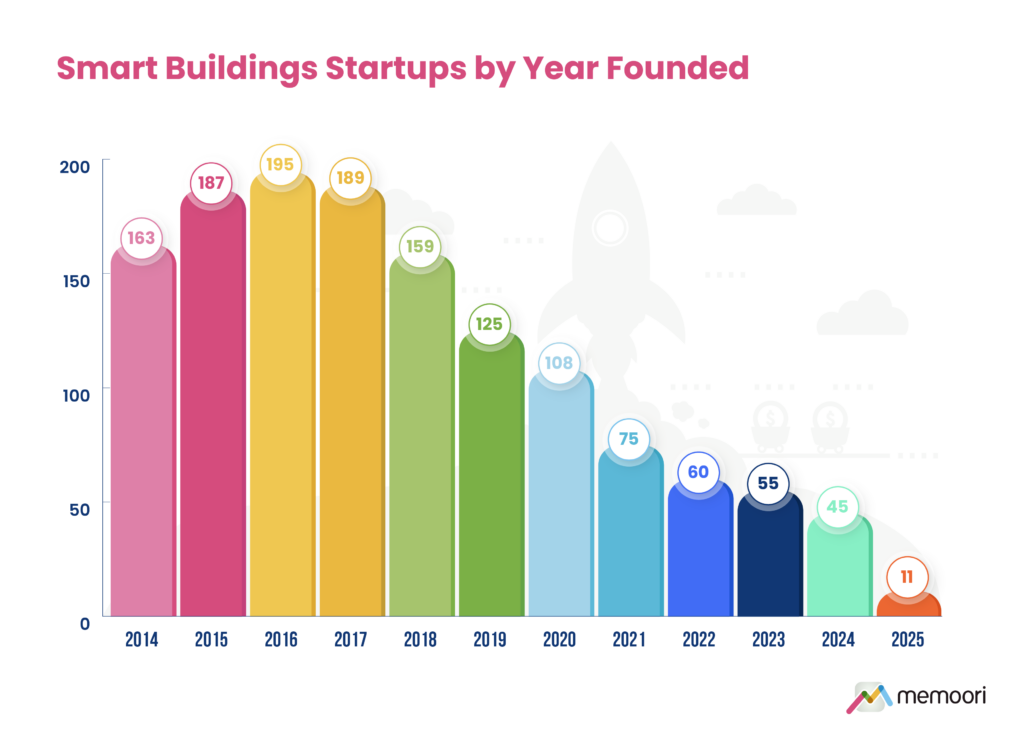
We identified only 11 new startups founded in 2025, and there has been a steady decline from the peak of 195 in 2016.
At the same time, acquisition activity has exploded. We recorded 98 startup acquisitions in 2025, a 75% increase on 2024 and the highest annual total in the last decade. Since 2014, 554 startups have been acquired in the smart commercial buildings sector. This consolidation signals a maturing market where proven business models are commanding attention from strategic buyers.
A Tough Environment for Startups
Despite fewer new companies entering the market, capital continues to flow to established players with solid fundamentals. Funding from venture capital, private equity, and corporate backers reached $6.5 billion in 2025, spread across 281 funding rounds. Down on last year, but not by much. Over the last decade, more than $55 billion has been invested in startups.
But the investment environment has become far more selective. The average value of Seed and Series A investments has increased; investors are being much more careful about where they place their bets. Even major players are pulling back. Fifth Wall, one of the most visible investors in climate and real estate technologies, has cut staff and stopped active fundraising.
Corporate stakeholders are playing an increasingly significant role, participating in 23% of all 2025 investments. Building automation incumbents, real estate service firms, HVAC equipment companies, and physical security providers are all actively building relationships, often as a precursor to acquisition.
AI Takes Center Stage
Our 2026 report expands coverage to address the technology reshaping the entire building lifecycle: artificial intelligence.
Only 27% of architecture, engineering, and construction (AEC) firms use AI today. But 94% of those firms plan to increase investment in 2026. Early adopters are already reporting strong returns, 68% have saved over $50,000, and 46% have saved 500 to 1,000 hours annually.
In response, part 2 of our report profiles 84 startups applying digital twin and AI technologies across the AEC/O lifecycle, from architecture and design through engineering, construction, and operations. We provide a detailed analysis of 20 featured companies, examining their technology focus, funding history, and strategic positioning.

What Does This Mean for 2026?
We expect the consolidation trend to continue. Funding will shift toward fewer deals with larger rounds and heavier strategic participation. Strategic buyers will move from minority investments to full acquisitions and platform consolidation.
For investors evaluating smart building opportunities, for strategic acquirers seeking targets, and for technology vendors assessing competitive positioning, understanding this landscape has become essential.
Our report provides the data and analysis to navigate it: complete listings of 2025 funding rounds, corporate investors, M&A activity, and detailed startup profiles across 5 comprehensive appendices.
The PropTech startup boom created hundreds of innovative companies. The consolidation phase will determine which of them survive, and who owns them.
The report is included in our 2026 Enterprise Subscription Service, also our Individual Subscribers receive a 10% discount.