Acuity AI Strategy in Smart Buildings: An Independent Assessment
How the only major building technology company betting on a unified occupant sensory experience — converging light, sound, air, and video through edge AI and a $1.2B audio-visual acquisition — is pursuing a fundamentally different thesis from every HVAC-centric competitor, with both category-defining upside and concentrated strategic risk.
From The Competitive Landscape for AI in Commercial Buildings 2026The Strategic Picture
Acuity (formerly Acuity Brands, rebranded to Acuity Inc. in January 2026; NYSE: AYI) delivered FY2025 revenues of $4.35B and reported Q1 FY2026 (ended November 30, 2025) revenue of $1.14B, a 20.2% year-over-year increase driven primarily by the QSC consolidation. FY2026 guidance of $4.7–4.9B with EPS of $19.00–$20.50 confirms the growth trajectory. Headquartered in Atlanta, Georgia, and led by CEO Neil Ashe, Acuity occupies a distinctive position among smart building technology companies — it is the only major player building its Acuity AI strategy around occupant experience rather than HVAC efficiency or energy management.
Understanding the Acuity AI strategy requires grasping a structural reality that sets it apart from every other company on Memoori’s coverage list. Acuity operates two segments: ABL (Acuity Lighting and Lighting Controls), which accounts for approximately 78% of revenue at roughly $3.4B and makes Acuity the largest lighting manufacturer in North America; and AIS (Acuity Intelligent Spaces), the high-growth technology segment that includes Distech Controls, Atrius, and now QSC. With QSC fully consolidated, AIS is approaching an annual run rate of $800M–$1B. H1 FY2026 saw AIS generate $248.1M in Q2 alone, with adjusted operating profit of $48M.
The January 2026 rebranding from Acuity Brands to Acuity Inc. is not cosmetic. It signals that the company’s strategic identity is shifting from lighting manufacturer to intelligent spaces platform. That ambition is real, but the revenue structure tells a sobering story: ABL still generates roughly four out of every five dollars, meaning the Acuity AI strategy is aspirational relative to today’s revenue mix. The question is whether AIS can grow fast enough — and whether the QSC acquisition integrates cleanly enough — to justify the rebrand.
Acuity AI Strategy Timeline
The Acuity AI Portfolio
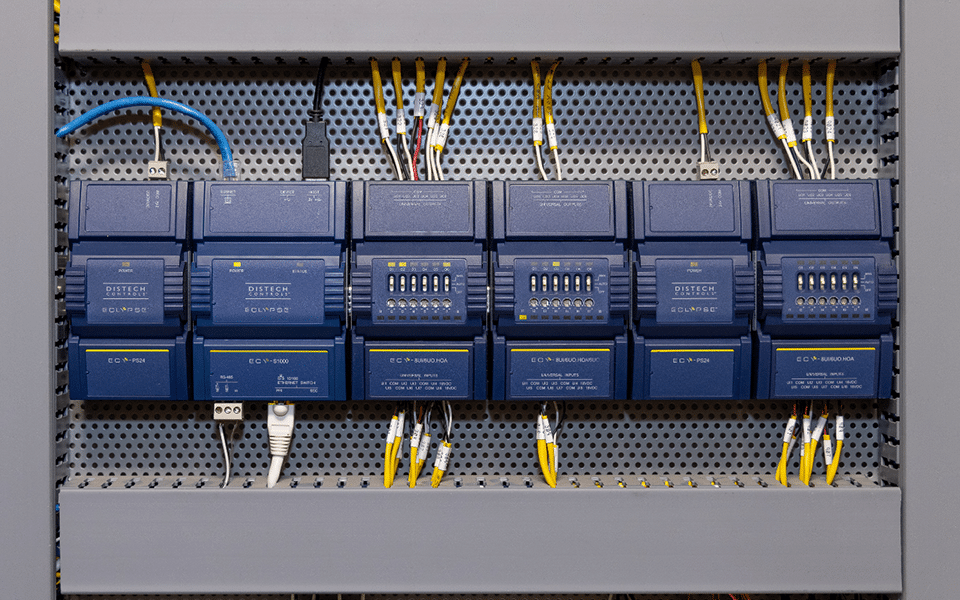
The Acuity AI strategy is anchored in a hardware-software stack that differs structurally from every other major building technology incumbent. Where Honeywell, Siemens, and Johnson Controls build their AI platforms atop HVAC equipment install bases and operational technology middleware, Acuity builds from the edge upward — starting with the ECLYPSE Apex controller and extending through Distech Controls BAS, nLight lighting controls, QSC audio-visual, and Atrius cloud analytics. The result is a portfolio oriented around occupant experience rather than mechanical system optimization.
ECLYPSE Apex Edge Controller
The ECLYPSE Apex is the most powerful controller in Distech Controls’ ECLYPSE family and the hardware foundation of the Acuity AI strategy. It features an AI core processor purpose-built for edge inference, Docker containerization that allows third-party applications to run directly on the controller, MQTT protocol support for modern IoT integration, and scalability up to 320 I/O points. The Apex enables autonomous HVAC and lighting routines using AI at the edge, with predictive maintenance capabilities that do not require cloud connectivity. This is a meaningful architectural choice: by placing AI processing at the edge rather than requiring cloud round-trips, Acuity addresses latency and reliability concerns that building operators consistently raise about cloud-dependent platforms.
Distech Controls Building Automation
Acquired around 2015 and headquartered in Montreal, Canada, Distech Controls is a BACnet-native, open-protocol building automation system with particular strength in North American commercial buildings. The open-protocol philosophy is a deliberate differentiator within the Acuity AI strategy — Distech Controls does not lock customers into proprietary communication standards, which lowers integration barriers and appeals to building operators managing multi-vendor environments. The ECLYPSE controller family sits at the centre of this ecosystem, providing the edge intelligence layer that connects field devices to cloud analytics.
ECLYPSE Facilities
Formerly ECLYPSE Building Intelligence, ECLYPSE Facilities is a multi-site BAS platform for centralized monitoring and management of building portfolios. This rebrand reflects the Acuity AI strategy’s expansion from single-building automation to portfolio-level intelligent operations — a necessary evolution for enterprise customers managing hundreds or thousands of sites. The platform provides unified visibility across disparate building systems and controller types.
Atrius Sustainability
Atrius Sustainability is Acuity’s cloud-based ESG and carbon tracking platform, used by Fortune 500 companies for real-time carbon footprint monitoring and ESG reporting compliance. As regulatory mandates around emissions disclosure expand globally, the Atrius platform positions the Acuity AI strategy to capture recurring software revenue from enterprise sustainability teams — a market adjacent to but distinct from traditional building automation.
nLight Intelligent Lighting Controls
nLight is Acuity’s intelligent lighting control ecosystem with embedded sensors that provide occupancy data feeding building intelligence. Within the Acuity AI strategy, nLight serves a dual purpose: it controls lighting (Acuity’s core business) and it generates occupancy data that informs HVAC scheduling, space utilization analytics, and building-wide AI models. The sensor network embedded in lighting fixtures creates a data collection layer that requires no additional hardware installation — a structural advantage over competitors that must deploy separate sensor networks.
QSC Q-SYS Platform
The $1.2B QSC acquisition, closed January 1, 2025, added approximately $500M in annual revenue and brought the Q-SYS audio, video, and control platform into the Acuity AI strategy. Q-SYS manages conferencing, paging, background audio, digital signage, and room control through a single software-defined platform. It includes Q-SYS Designer, a development environment that enables third-party developers to build custom AV solutions. The Q-SYS developer ecosystem is a genuine asset — it creates platform lock-in through third-party investment rather than proprietary protocols.
The Acuity AI strategy’s product portfolio is architecturally distinctive but strategically concentrated. The ECLYPSE Apex with its AI core processor and Docker containerization is arguably the most capable edge controller in the building automation market for its class. The combination of Distech Controls BAS, nLight sensors, QSC AV, and Atrius cloud creates a stack that no competitor has assembled. But this is a portfolio built for the occupant experience thesis — if the market rewards HVAC optimization and energy management instead, several of these components (particularly QSC) lack clear integration points with the building automation conversation that dominates industry investment. For the full competitive assessment, see Memoori’s AI in Smart Commercial Buildings 2026–2031.

The Sensory Building — From Lighting to Light, Sound, and Air
Every other major building technology company on Memoori’s coverage list — Honeywell, Siemens, Johnson Controls, Carrier, Trane Technologies, Schneider Electric — approaches smart buildings through some combination of HVAC efficiency, energy management, or operational technology. The Acuity AI strategy is the only one built around a unified occupant sensory experience: lighting (nLight and the ABL portfolio), sound (QSC Q-SYS), air quality (Distech Controls HVAC), and visual/video (QSC conferencing and control). This is not a marginal distinction. It is a fundamentally different thesis about what smart buildings are for.
The $1.2B QSC acquisition is the strategic linchpin. It is a bet that buildings will converge light, sound, air, and video into a single intelligent environment managed by AI. The ECLYPSE Apex with its AI core processor and Docker containerization is positioned as the convergence point at the edge — a controller capable of orchestrating HVAC routines, lighting scenes, audio zones, and video systems through a unified intelligence layer. No other controller in the market attempts this breadth of system convergence.
The competitive implications are stark. Honeywell’s Niagara Framework aggregates operational data from building systems but does not manage audio-visual environments. Siemens Building X targets autonomous building operations across HVAC, lighting, and security but has no AV integration thesis. Johnson Controls OpenBlue deploys AI agents for building management but operates within the traditional BAS perimeter. Carrier Abound and Trane Technologies’ intelligent services focus almost exclusively on HVAC depth. None of these competitors is building toward a sensory convergence platform.
The January 2026 rebranding from Acuity Brands to Acuity Inc. signals the depth of commitment to this thesis. A lighting company does not rename itself unless leadership believes the future lies beyond lighting. The rebrand, combined with the QSC acquisition and the ECLYPSE Apex development, represents a coherent strategic bet — but it is a bet on a category that does not yet exist in the way Acuity envisions it. The Acuity AI strategy is either visionary or premature, and the market will determine which within the next two to three years.
Memoori observes that the occupant experience thesis has structural tailwinds that merit serious attention. Hybrid work has made the quality of the in-office experience a competitive differentiator for employers. Wellness certifications (WELL, Fitwel) increasingly require integrated environmental controls. Conference room technology spending has surged as organizations invest in hybrid meeting infrastructure. These trends individually support elements of Acuity’s portfolio. The question is whether they converge into a unified buying decision — a single platform purchase for light, sound, air, and video — or remain separate procurement categories managed by different stakeholders within the building.
How does the Acuity AI strategy compare to peers?
Memoori’s 2026 reports track AI acquisitions, product launches, and competitive positioning across every major incumbent and 360+ AI vendors — with strategic assessments and market sizing through 2031.
Where Acuity AI Strategy Stands: The Bottom Line
Memoori considers the Acuity AI strategy the most architecturally distinctive among building technology incumbents. No other company has assembled a stack that converges lighting, audio-visual, HVAC, and cloud sustainability into a single platform thesis anchored by edge AI hardware. But distinctive does not mean proven, and the Acuity AI strategy faces both genuine strengths and material risks that will determine whether the sensory building vision converts into a defensible market position.
What Works
The Acuity AI strategy excels in three areas. First, edge AI hardware: the ECLYPSE Apex with its AI core processor, Docker containerization, and 320 I/O point scalability is among the most capable edge controllers in the building automation market. Placing AI inference at the edge rather than requiring cloud connectivity addresses reliability and latency concerns that building operators consistently raise. Second, unique positioning: no competitor occupies the occupant sensory experience category. Acuity is the only company building toward unified light + sound + air + video intelligence, giving it first-mover advantage in a category that hybrid work trends, wellness certifications, and conference technology investment may validate. Third, cash generation: ABL’s dominant position as North America’s largest lighting manufacturer generates the cash flow that funds AIS growth, providing financial runway that pure-play technology competitors lack. The open-protocol BACnet philosophy through Distech Controls also reduces integration friction in multi-vendor building environments.
What Needs Proving
The Acuity AI strategy faces three structural challenges. First, the sensory building thesis is unproven as a market category. Light, sound, air, and video are currently procured by different stakeholders through different budget lines — facilities management buys HVAC, IT buys AV, and real estate buys lighting. Converging these into a single platform purchase requires a buying behavior change that no market signal has yet confirmed. Second, the $1.2B QSC acquisition is a concentration risk. If audio-visual and building automation converge as Acuity expects, QSC is transformative. If they remain separate markets, Acuity has paid a premium for a platform that does not integrate with the core building automation conversation. Third, ABL dominance cuts both ways: at 78% of revenue, lighting still defines what Acuity is in practice, regardless of what the rebrand aspires to communicate. The Acuity AI strategy must demonstrate that AIS can grow from its current ~$800M–$1B run rate to a position where it materially shapes the company’s identity and valuation multiple. Finally, Acuity lacks the HVAC equipment install base that gives Honeywell, Johnson Controls, Carrier, and Trane their data moats — the millions of chillers, air handlers, and rooftop units generating operational data that trains AI models.
The Acuity AI strategy represents the boldest category-creation bet in the building technology sector. The thesis that buildings should converge light, sound, air, and video into a single AI-managed sensory environment is intellectually compelling and supported by real trends in hybrid work, wellness, and occupant experience. The ECLYPSE Apex edge controller is genuine AI hardware, not a marketing rebrand of an existing product. The QSC Q-SYS platform brings a developer ecosystem and software-defined AV capability that no building automation competitor possesses. And ABL’s cash generation provides financial stability while AIS scales. But this is a company betting $1.2B on a market category that does not yet exist as a unified buying decision. The revenue structure remains 78% lighting. The HVAC data moat that defines competitor AI strategies is absent. The Acuity AI strategy will be validated or invalidated within two to three years: if occupant experience converges into a single platform purchase, Acuity will own an unopposed category with the only integrated stack. If it does not, the most distinctive positioning in the sector will remain a thesis rather than a market.
Get the Full Competitive Picture
This Acuity AI strategy assessment covers one company. Memoori’s 2026 reports cover every major incumbent, 360+ AI vendors, 69 use cases, market sizing through 2031, and strategic positioning across all 12 AI domains in commercial buildings.
Frequently Asked Questions
Related Company Strategies
Methodology: This analysis draws on Memoori’s Competitive Landscape for AI in Commercial Buildings (2024 and 2026 editions) and AI in Smart Commercial Buildings: Opportunities, Technologies & Applications, 2026–2031. Research methodology includes vendor briefings, public financial filings analysis, patent review, M&A tracking, and a proprietary quantitative scoring framework across 8 dimensions. Memoori does not accept vendor payment for inclusion or ranking. All financial data is sourced from Acuity’s public filings and earnings disclosures unless otherwise noted. Memoori estimates are derived from segment reporting and proportional analysis.