

The most comprehensive analysis available of who is building what, who is buying whom, and where capital is flowing in the smart building artificial intelligence market.
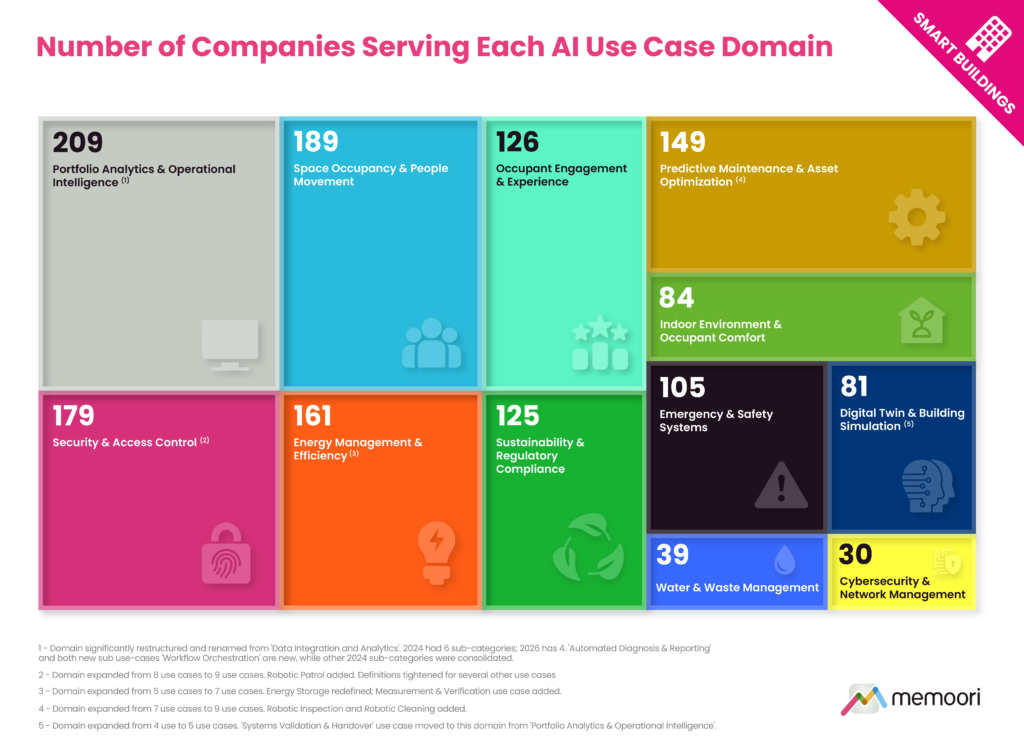
454 companies mapped, analyzed, and segmented by use case, company age, company size, and geography. This report maps the competitive landscape itself: who is building what, who is buying whom, and where capital is flowing.
It is the second of two sister reports, following AI in Smart Commercial Buildings: Opportunities, Technologies & Applications 2026, which covered market dynamics, technology foundations, and use case frameworks. Like ALL in-depth reports published this year, it is included in our 2026 Enterprise Subscription Service.
Why This Research Matters in 2026?
- Most AI used in commercial buildings watches rather than acts. In Indoor Environment, the share of deployed AI that closes a control loop sits well below half. In Predictive Maintenance, diagnostic alerting dominates over automated workflow integration. In Emergency & Safety, 73 companies carry detection capability against only 30 in incident response. The defensible moat in each domain is increasingly the workflow and control integration layer, because detection is commoditizing faster than workflow integration.
- The data center pivot is pulling incumbent attention away from commercial buildings. Siemens, Johnson Controls, Trane, Carrier, and Schneider Electric all report data center thermal management as their fastest-growing building-adjacent business. Siemens’s Smart Infrastructure data center orders were up 60% year-on-year to €3.6 billion, while commercial buildings were cited as a drag. Capital and executive attention will follow that growth, creating a risk that commercial buildings AI investment is deprioritized at precisely the point where multi-domain convergence platforms need sustained commitment.
- Our dataset for this research grew 24.7%, but genuine new entrants are scarce. Only 34 companies founded in 2022 or later entered the dataset. Most domain growth reflects existing companies adding AI capabilities, repositioning their marketing, or being captured by broader research scope. The fastest-expanding domains; Water & Waste Management (+129.4%), Emergency & Safety Systems (+118.8%), and Sustainability & Regulatory Compliance (+115.5%), are being pulled forward by regulation, not by waves of new startup formation.
- Nearly every major commercial buildings automation vendor depends on Microsoft Azure OpenAI services for their underlying AI infrastructure. The incumbent tier does not own its foundation models and, in most cases, does not run its own cloud infrastructure, creating a layer of platform economics it neither controls nor can cost-effectively replicate. What does this mean for the industry going forward?
454 Companies Mapped Across 12 AI Use Case Domains and 69 Individual Use Cases
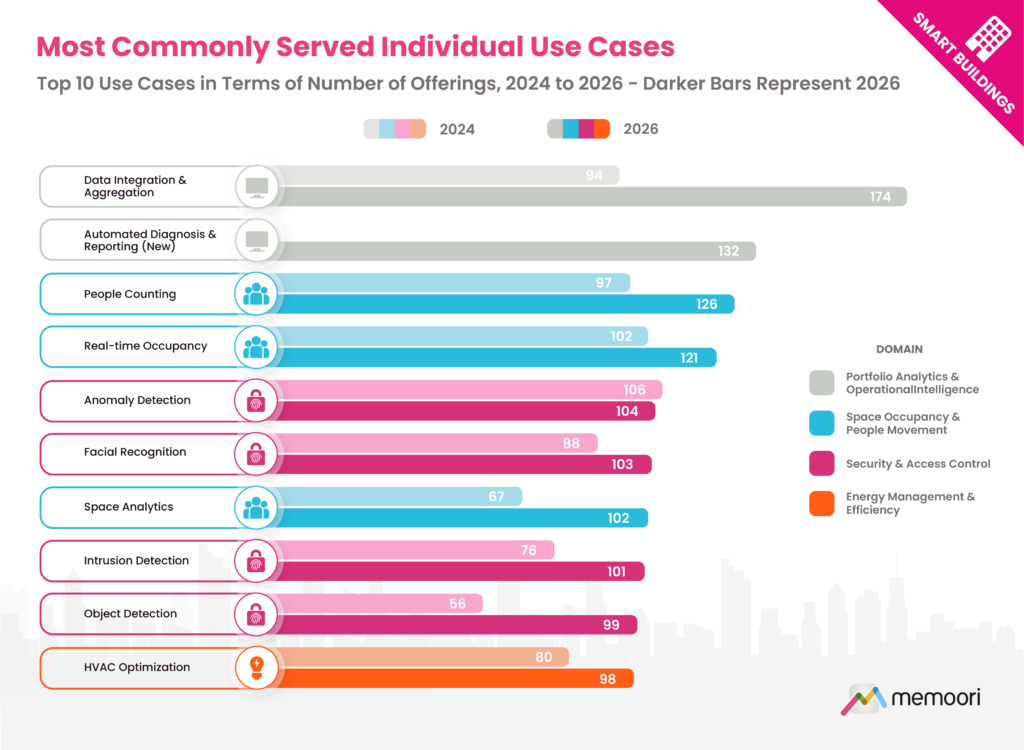
The report maps every company in the dataset against 12 AI use case domains and 69 distinct individual use cases where AI is being actively developed or commercialized for the smart commercial buildings market. An accompanying spreadsheet provides granular company-level data.
Within each domain we profile 6 notable companies in detail, providing a total of 72 domain-level profiles. Chapter 3 adds a further 15 major cross-domain players, covering building automation incumbents, major technology firms, and physical security market leaders.
Cross-Domain Strategic Themes
AI capability has moved from differentiator to baseline. Foundation model APIs have made conversational interfaces and document extraction close to free to implement. The differentiator has moved to whether the AI is wired into specific building outcomes at a level that can be independently verified. Buyers are specifically asking what the AI is doing beyond the interface layer before progressing procurement.
Hardware ownership correlates with stronger evidence and defensible moats in several domains. In water management, security, emergency systems, and occupancy sensing, companies that deploy proprietary sensors hold traceable data pipelines and proprietary training datasets that software-only competitors cannot access.
The real ceiling is deployment capacity, not vendor capability. Deployments that materially shift building outcomes sit at an estimated 7–8% (Level 2) and under 1% (Level 3) of the commercial buildings stock. Unless the workforce picture shifts, the market’s upper bound through 2031 will be set by deployment capacity rather than vendor capability.
Regulatory mandates are converting discretionary technology purchases into compliance requirements. The CSRD, EPBD Recast, NYC Local Law 97, EU AI Act, and commercial buildings performance standards are primary demand drivers across energy, sustainability, indoor environment, and security domains. Vendors with audit-ready evidence trails hold structural advantages over those with superior algorithms but weaker compliance documentation.
Consolidation Outlook Through 2031
Infrastructure private equity has emerged as a new acquirer archetype at a scale not seen in prior editions. Actis acquired Barghest Building Performance, PATRIZIA and Mitsui committed up to $350 million to Kaer, and Redaptive secured a $650 million credit facility from CDPQ and Nuveen. The underwriting logic is contracted project yield, not software multiple, supporting capital structures 10–50x larger than pure software competitors.
By 2028, the independent AI-native commercial buildings specialist category will contract further. The competitive centre of gravity will shift from “AI-native startup versus building incumbent” to “incumbent with acquired AI capability versus enterprise IT platform with building data layer.”
The question for future research will not be whether consolidation happened, but whether acquired specialist capability was integrated into platforms that deliver on the AI promise, or absorbed into legacy architectures that produced incremental rather than transformational advantage.
Who Should Buy This Report?
This research will be valuable to:
- Technology vendors and solution providers who need to understand where buyer readiness, regulatory pressure, and competitive dynamics are creating the most defensible near-term opportunities, and where the market is consolidating beneath them.
- Building systems manufacturers assessing how AI capability is being absorbed through acquisition, where the build-versus-buy window is narrowing, and which specialist targets remain independently available.
- Investors (VCs, PE firms, corporate VC arms) evaluating where durable value is being created, which funding patterns signal acquisition staging rather than independent scaling, and where capital is crowding into overserved segments while underserved pockets go unattended.
- Commercial building owners and operators seeking an independent framework for evaluating vendor claims, understanding which corporate parents may change before a contract matures, and making architectural choices that will persist well beyond 2031.
- Smart building consultants and system integrators who need a current, evidence-based competitive map to inform client advisory work, including which vendor archetypes face the highest exposure and where the specialist-versus-platform tension is heading.
Priced at $3,000 USD for an Enterprise-Wide License. Individual subscribers receive a 10% discount. Want to know more? Download the Brochure.